WCAG Accessibility Compliance Roadmap for Indian Startups and SMEs!




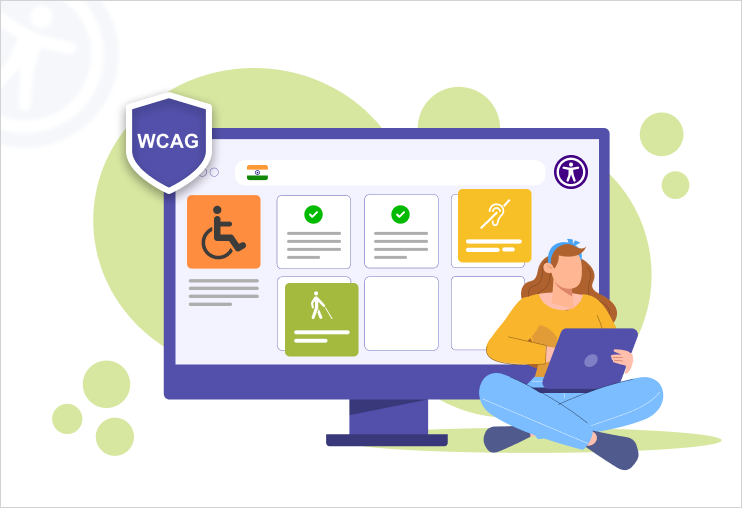
In India’s rapidly digitizing economy, accessibility has become a legal, ethical, and strategic imperative. With increasing alignment to global standards and the Rights of Persons with Disabilities Act, 2016, businesses are expected to ensure inclusive digital experiences.
However, for startups and SMEs, WCAG (Web Content Accessibility Guidelines) implementation can feel overwhelming. Because approaching compliance is not a one-time checklist – it is a structured, phased roadmap.
Read along to understand.
WCAG and the Indian market: An interesting context!
WCAG is a globally recognized framework developed by the W3C to make digital content accessible to people with visual, auditory, cognitive, and motor impairments.
Interestingly, most accessibility regulations, including India’s government guidelines (GIGW 3.0), align with WCAG 2.1 Level AA, which is considered the practical benchmark for compliance.
At its core, WCAG is built on four principles (POUR):
- Perceivable
- Operable
- Understandable
- Robust
Indian startups & SMEs need to take appropriate actions: Reasons
Accessibility is becoming a business differentiator:
- Legal readiness: Aligns with Indian regulations and global expansion needs.
- Market expansion: India has a profound number of users with disabilities.
- Better UX & SEO: Accessibility improves usability and discoverability.
- Investor confidence: ESG, CSR strategy, and inclusive design are gaining traction.
In short, accessibility is growth, not just compliance.
WCAG compliance roadmap: A right path to follow
Phase 1: Awareness & commitment
Start with internal alignment.
Key actions:
- Educate leadership and teams about the impact of accessibility.
- Define accessibility goals (typically WCAG 2.1 AA).
- Assign ownership (design, dev, QA, content teams).
Treat accessibility as part of the organization’s product strategy, not a side initiative.
Phase 2: Accessibility audit & gap analysis
If issues cannot be measured, they cannot be fixed.
Steps:
- Conduct automated audits (quick wins).
- Perform manual accessibility audits (deep usability issues).
- Map issues to severity and user impact.
Common issues in Indian SME platforms accessibility:
- Missing alt text
- Poor color contrast
- Non-accessible forms
- Keyboard navigation failures
Prioritizing critical user flows (signup, checkout, onboarding) is essential.
Phase 3: Prioritization & planning
Not all issues are equally important.
Use an impact matrix:
- High impact + high frequency = Fix first
- Legal risk areas = Prioritize immediately.
- UX blockers = Address early
Focus on navigation, forms, content readability, and mobile accessibility.
Phase 4: Design-led accessibility
Shift accessibility left into design.
Best practices:
- Color contrast compliance.
- Clear typography & spacing.
- Accessible components (buttons, forms, modals).
- Consistent navigation patterns.
For example, WCAG requires that information conveyed by color must also be available in text, ensuring usability for color-blind users.
Phase 5: Development & implementation
Embed accessibility into code.
Developer checklist:
- Semantic HTML
- Keyboard operability
- ARIA labels (where needed)
- Proper heading structure
- Form labels and error handling
Remember, WCAG is an outcome-based, not code-specific framework. It defines what to achieve, not how to.
Phase 6: Testing & validation
Accessibility testing is continuous.
Approach:
- Automated testing tools
- Screen reader testing (NVDA, VoiceOver)
- Keyboard-only navigation
- Real user testing (if possible)
Indian government guidelines also emphasize manual evaluation using assistive technologies for true compliance.
Phase 7: Documentation & compliance statement
Transparency builds trust.
Include:
- Accessibility statement on website
- Known limitations.
- Contact for feedback.
This is especially important for global clients and enterprise partnerships.
Phase 8: Continuous monitoring & scaling
Accessibility cannot be achieved through one-time fix.
Build systems:
- Integrate accessibility into CI/CD pipelines.
- Create reusable, accessible design systems.
- Train teams regularly.
As a digital product evolves, its accessibility ought to be maintained.
Common challenges for Indian SMEs and ways to overcome them
- Limited budget and resource constraints
For early-stage startups and SMEs, accessibility can be an extra expense and not a necessity.
This issue arises due to:
- Lack of dedicated accessibility budgets.
- Smaller teams handling multiple roles.
- Pressure to prioritize short-term business goals.
How to overcome it:
- Start with low-cost, high-impact fixes like adding alt text.
- Use free and open-source tools for initial audits.
- Prioritize critical user journeys (login, checkout, onboarding) instead of the entire platform.
- Lack of accessibility expertise
Accessibility is still a niche skill in India, and many teams simply don’t know where to begin or how to interpret WCAG standards.
It happens due to:
- Limited exposure to accessibility in design/dev education.
- WCAG documentation can feel technical and complex.
- Misconception that accessibility requires specialized teams.
How to overcome it:
- Upskill internal teams through workshops and accessibility training.
- Make simple internal checklists aligned with WCAG Level AA.
- Start with basic accessibility principles (POUR) before diving into the depth of various success criteria.
- Collaborate with accessibility consultants for initial guidance.
- Time-to-market pressure
Startups often prioritize speed – launching fast and iterating later, and this approach impacts accessibility.
The reasons behind this problem are:
- Aggressive release cycles.
- MVP-first mindset.
- Accessibility is seen as “non-blocking”.
How to overcome it:
- Embed accessibility into the design and development lifecycle.
- Include accessibility checks in the definition of done (DoD).
- Use component-based design systems with built-in accessibility.
- Automate testing wherever possible to save time.
- Legacy systems and technical debt
Many SMEs operate on older platforms or codebases that were never designed with accessibility in mind.
This issue grows due to:
- Outdated CMS or frameworks.
- Lack of documentation.
- Regular feature additions without refactoring.
How to overcome it:
- Conduct a phased remediation plan instead of a full redesign.
- Prioritize frontend fixes that improve usability quickly.
- Gradually refactor critical components.
- Consider accessibility during platform upgrades or redesigns.
- Misconception that accessibility impacts a smaller audience segment
Digital accessibility is not limited to a group of users; it is for everyone trying to explore content online.
This misconception exists due to:
- Lack of awareness about the scale of disability in India.
- Accessibility is seen as a compliance checkbox.
How to overcome it:
- Educate stakeholders about accessibility and its wider scope.
- Highlight benefits like better SEO, mobile usability, and performance.
- Share real-world examples where accessibility improvement has increased engagement.
- Frame accessibility as inclusive design.
- Limited user testing with assistive technologies
Several SMEs rely only on automated tools and miss real-world usability issues faced by users with disabilities.
It happens due to:
- Lack of access to assistive technology for users.
- Limited awareness of testing methods.
- Over-reliance on automation.
How to overcome it:
- Combine automated + manual testing.
- Test with screen readers and keyboard navigation.
- Partner with organizations or communicate for user testing.
- Include accessibility checks in QA processes.
WCAG compliance is the future of the Indian digital world
May be a full WCAG product exist but it may still have usability gaps if not designed thoughtfully. Accessibility must go beyond checklists, toward inclusive experiences.
Startups that embrace right approach early will:
- Build stronger brands
- Reach wider audiences
- Stay ahead of regulatory changes.
In a nutshell,
For Indian startups and SMEs, WCAG compliance is not just about avoiding risks, it’s about unlocking opportunities. A structured roadmap makes accessibility journey achievable, scalable, and impactful.
Digital accessibility is the foundation of digital success today!
So, ready to make your digital platforms inclusive and WCAG-compliant?
We help Indian startups and SMEs implement inclusivity with accessibility widget, and its add-ons from audit, remediation to continuous monitoring, and support. Reach out to hello@skynetindia.info if you want to transform accessibility into your competitive advantage.