A Complete Guide to India’s IS-17802 Digital Accessibility Mandate for ICT Products and Services Websites!




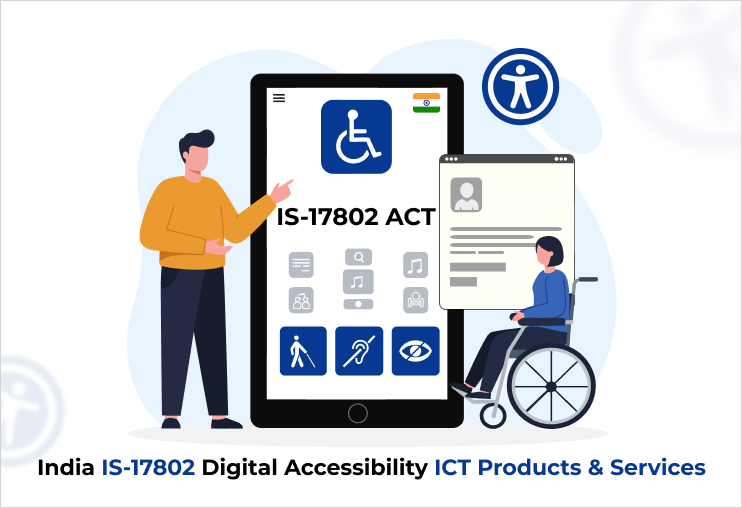
In the era of continuous and rapid digital transformation, technology is no longer a luxury – it is the primary gateway to essential services, including education, healthcare, communication, banking, civic participation, and employment. Yet, for millions of people with disabilities, digital platforms and products often remain inaccessible due to web design barriers that assume able-bodied interaction by default.
To bridge this divide, India has taken a landmark step by introducing IS-17802, a comprehensive accessibility standard for Information and Communication Technology (ICT) products and services that now carries legal force under Indian law.
What is IS-17802 India Digital Accessibility?
IS-17802 is the Indian national standard titled “Accessibility for ICT products and services”. It is published by the Bureau of Indian Standards (BIS) and consists of two parts:
- Part 1 – Requirements: Functional and technical accessibility requirements for ICT systems.
- Part 2 – Determination of Conformance: Methods and procedures to assess whether a product or service meets the accessibility criteria.
This standard applies to hardware, software, digital content, systems, and services across the entire digital ecosystem – including websites, mobile apps, kiosks, ATMs, television interfaces, digital documents, communication platforms, and emergency services.
How did IS-17802 become mandatory?
While BIS standards historically were voluntary, a significant legal shift occurred in May 2023 when the Rights of Persons with Disabilities (Amendment) Rules, 2023 were notified. These rules amended the Rights of Persons with Disabilities (RPwD) Rules, 2017, and incorporated IS-17802 parts 1 and 2 under Rule 15 – Accessibility Standards. This effectively made compliance with the ICT accessibility standard a legal obligation for establishments in India.
Under this amendment, entities – both in the public and private sectors – must ensure that websites, applications, ICT-based services, consumer products, assistive accessories, and related digital systems comply with IS-17802 accessibility requirements.
Why IS-17802 matters?
- Legal and human rights context
- Universal digital inclusion
- Alignment with international standards
The Rights of Persons with Disabilities Act, 2016 (RPwD Act) mandates equal access and non-discrimination across all spheres of life, including access to information and technology. IS-17802 gives teeth to this principle by translating broad legal obligations into specific, testable accessibility requirements that digital products and services must meet.
IS-17802 emphasizes that digital services must be perceivable, operable, understandable, and robust for users with diverse abilities – including those with visual, auditory, motor, speech, and cognitive disabilities. Examples include supporting screen readers, keyboard accessibility, captions for multimedia, alternative text for images, contrast legibility, and compatibility with assistive technologies.
This means that a person with vision impairment should be able to navigate a government portal or mobile app independently, just like anyone else. Similarly, someone with hearing loss should have access to captions or alternative communication modalities in digital interfaces. And/or other users with/without disabilities can complete their tasks online easily.
India’s IS-17802 is broadly aligned with globally recognized frameworks such as the Web Content Accessibility Guidelines (WCAG 2.1) and other international accessibility norms such as the European EN 301549 standard. This helps bring Indian digital products in line with global best practices while adapting to local linguistic and contextual needs (e.g., support for multiple Indian languages).
Who must comply?
The mandate applies to a wide range of stakeholders:
- Government departments and e-governance platforms.
- Private sector service providers with digital products or services offered in India.
- Educational institutions delivering online learning and digital documents.
- Financial, healthcare, and telecom domains that interface with users digitally.
- Manufacturers of consumer ICT products, including hardware and software systems.
Failure to comply can lead to redressal actions under the RPwD Act, including complaints to the Chief Commissioner for Persons with Disabilities, legal scrutiny, and potential regulatory consequences.
What compliance looks like in practice?
To demonstrate compliance with IS-17802, organizations may need to:
- Conduct accessibility audits for all ICT assets.
- Produce VPAT / Accessibility Conformance Reports (ACRs) that explain how products meet standard criteria.
- Include accessibility criteria in procurement policies and product development lifecycles.
An accessible ICT product is one where assistive features are built in from the design stage – rather than retrofitted after the audit. For example:
- Websites that can be navigated via keyboard alone.
- Apps with adjustable text and color contrast settings.
- Hardware interfaces (like kiosks) with tactile controls and clear audio/visual feedback.
- Digital documents are formatted so that screen readers can interpret them reliably.
What are the broader impacts and benefits?
Social and economic inclusion
By ensuring equitable access to digital platforms, IS-17802 enables persons with disabilities to participate fully in education, employment, and social interaction.
Business advantage
For enterprises, accessibility improves usability for all users – not just those with disabilities. Accessible design often enhances SEO, reach, customer satisfaction, and brand reputation.
Government service delivery
Accessible digital services are more effective and user-centric, particularly for initiatives such as digital payments, citizen services, and public information systems.
Also read about Regional Language Digital Accessibility in India.
Wrapping up
The implementation of IS-17802 is part of a larger national commitment to inclusive digital governance. With ongoing technological evolution – including AI, voice interfaces, and IoT devices – accessibility standards will likely continue to evolve, ensuring that technology serves all citizens equitably.
IS-17802 is more than a compliance requirement; it is a social and ethical imperative that defines how India builds an inclusive digital future – where access to technology is a right, not a privilege.
Looking to meet the IS-17802 mandate with confidence? We help you achieve full compliance with ease. Our AI accessibility widget with comprehensive paid add-on services like WCAG-aligned audits, remediation services, PDF / document accessibility remediation, and ongoing support ensure your digital assets stay inclusive, user-friendly, and regulation-ready. Whether you need rapid deployment or comprehensive accessibility transformation, our experts are here to guide you every step of the way – empowering your organization to create truly accessible digital experiences for all. Reach out hello@skynetindia.info for more information.