Digital Accessibility in India: A Core Pillar of ESG and CSR Strategy




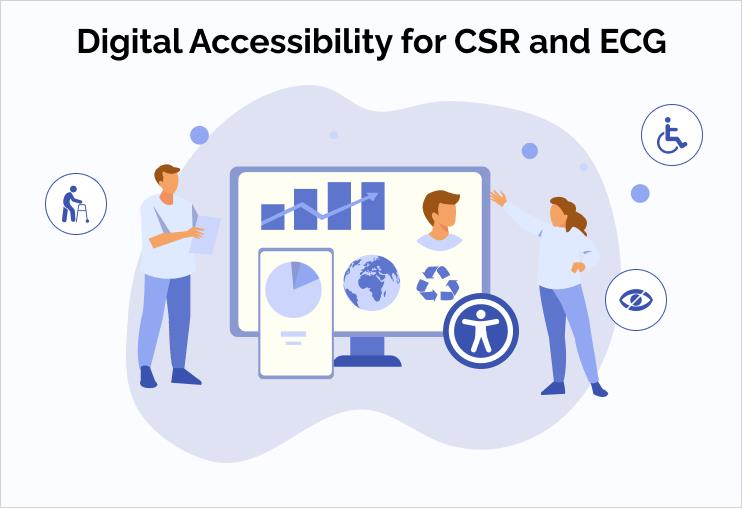
Doing good always yield goodness around; isn’t it?
And that’s why corporates make sure to run ESG (Environmental, Social, and Governance) and CSR (Corporate Social Responsibility) activities.
So, these rapidly evolving commitments are now strategic pillars that drive long-term business resilience, societal impact, and investor confidence for organizations. Within this paradigm shift, accessibility – particularly digital accessibility – has emerged as a critical yet undervalued aspect of ESG framework and for impactful CSR initiatives.
For India, a nation undergoing digital transformation at scale, inclusive design and accessibility are not just ethical imperatives but strategic necessities to ensure equitable participation for all citizens.
Defining accessibility and its dimensions
Accessibility refers to the design and delivery of products, services, environments, and communications in a manner that enables a person, regardless of ability or disability, to understand, access, and benefit from them.
Key dimensions include:
- Digital accessibility
- Communication accessibility
- Service accessibility
- Physical accessibility
Ensuring websites, mobile applications, documents, and digital services conform to accessibility standards like WCAG (Web Content Accessibility Guidelines), ADA, EAA, and other.
Providing alternative communication modes – captions, sign language interpretation, accessible print/Braille, plain language content, and multilingual options.
Processes and customer support are designed for diverse needs, including assistive technology compatibility, helplines, and inclusive user journeys.
Designing buildings, transport systems, workspaces, and public areas that accommodate mobility needs (e.g., ramps, tactile paths, accessible restrooms).
Each of these dimensions intersect with the social criteria of ESG and expands the impact potential of CSR interventions.
Reasons of making accessibility a crucial part of ESG
- Social inclusion and equity
The ‘S’ in ESG is ‘Social’ that focuses on people – employees, customers, communities, and supply chains. Accessibility directly aligns with:
a. Human rights norms, including the UN Convention on the Rights of Persons with Disabilities (UNCRPD), to where India is a signatory.
b. Equitable access to opportunities, information, jobs, and essential services.
c. Organizational diversity and inclusion goals, enhancing representation.
When digital services, workplaces, and public interfaces are accessible, they empower individuals with disabilities, ageing populations, and other marginalized groups to participate fully in society and the economy.
- Regulatory and policy landscape in India
- Rights of Persons with Disabilities (RPwD) Act, 2016.
- Mandates about equal access to information, infrastructure, education, and services.
- Guidelines for Indian Government Websites (GIGW).
- Requires government digital platforms to adhere to accessibility standards.
India has steadily strengthened its accessibility frameworks:
- National Digital Governance and e-Governance strategies
For businesses participating in public procurement, government partnerships, or serving regulated sectors, adhering to accessibility standards is increasingly intertwined with compliance expectations.
- ESG reporting and disclosure requirements
- Demonstrate measurable inclusion initiatives.
- Strengthen community impact narratives.
- Enhance social performance metrics for investors and rating agencies.
Leading ESG reporting frameworks – including SEBI’s Business Responsibility and Sustainability Report (BRSR) requirements – emphasize social impact, inclusivity, and stakeholder engagement.
Integrating accessibility into ESG disclosures can help organizations:
Accessibility metrics can range from digital compliance scores to the number of beneficiaries served through inclusive CSR programs.
Read more: How to improve WordPress website accessibility?
Accessibility as a CSR imperative
Given its societal impact, accessibility dovetails naturally with CSR initiatives. It strengthens the outcomes and reaches of core CSR focus areas:
- Education and skill development
- a. Enable students with visual, hearing, cognitive, or motor impairments to participate fully.
- b. Improve outcomes in digital literacy programs in underserved communities.
- c. Expand vocational training for employability.
Accessible education platforms and learning materials:
- Healthcare and wellbeing
Integrating accessibility in healthcare initiatives – telemedicine, appointment systems, and awareness campaigns – ensures that persons with disabilities can access critical services without barriers.
- Livelihood and economic empowerment
- a. Accessible digital tools and training open pathways to employment, entrepreneurship, and financial inclusion.
- b. CSR programs targeting skill-building can incorporate accessibility training for target groups and local partners.
- Community infrastructure projects
When CSR invests in community centers, public facilities, or digital hubs, ensuring physical and digital accessibility broadens community impact and delivers equitable benefits.
Organizations can implement accessibility in ESG and CSR; how?
- Conduct baseline assessments and audits
- a. Digital assets (websites, apps, documents).
- b. Physical infrastructure (offices, retail outlets, support centers)
- c. Communication and outreach materials.
- d. Benchmark against WCAG, RPwD standards, and global best practices.
Start with comprehensive accessibility audits across:
- Set clear accessibility goals
- a. Percentage of digital assets remediated to WCAG 2.1 AA level.
- b. Number of employees trained in inclusive design.
- c. CSR projects integrated with accessibility interventions.
Define measurable objectives such as:
Goals should align with broader ESG targets and be time-bound.
- Embed accessibility in design and procurement
- a. In product development lifecycles.
- b. In vendor and procurement criteria.
- c. In partner selection for CSR programs.
Rather than retrofitting accessibility, embed it:
This ensures long-term sustainability of accessibility efforts.
- Train employees and stakeholders
- a. Designers and developers
- b. Product managers
- c. Marketing and communications
- d. CSR project leads
Accessibility knowledge should extend beyond compliance teams:
Workshops, certifications, and inclusive design sprints build internal capability.
- Measure, report, and communicate impact
- a. Accessibility compliance scores.
- b. User feedback and satisfaction among persons with disabilities.
- c. Case studies on community impact.
ESG reports, CSR disclosures, and stakeholder communications should include accessibility outcomes:
Transparent reporting enhances credibility and accountability.
Challenges of implementing ESG & CSR strategies and solutions
| Challenge | Solution |
|---|---|
| Lack of awareness about accessibility | Conduct corporate training and leadership workshops |
| Perceived cost burden | Quantify long-term business value and ROI of inclusion |
| Limited expertise | Partner with accessibility consultancies and NGOs |
| Fragmented implementation | Integrate accessibility into governance and performance metrics |
Recognizing challenges early enables strategic planning and targeted interventions.
Also read: India’s DPDPA Compliance for digital privacy
Accessibility as a strategic ESG and CSR priority!
Accessibility is more than a compliance requirement – it is a strategic differentiator, a driver of inclusion, and a measurable pathway for social impact. For India, integrating accessibility into ESG and CSR frameworks not only aligns with national policy goals but also accelerates equitable participation in the digital economy.
By committing to accessibility, organizations signal that growth and sustainability mean leaving no one behind. It’s time for accessibility to be recognized and operationalized as a central pillar of India’s corporate sustainability journey.
Empower organization to lead an inclusive digital practice with us. Integrating digital accessibility into ESG and CSR strategy not only meets compliance standards but also strengthens brand reputation and broadens audience reach. Leverage our accessibility widget and services to evaluate, monitor, and optimize digital assets for all users, including those with disabilities. Take proactive steps toward creating a more equitable online experience while showcasing commitment to social responsibility. Reach out hello@skynetindia.info to start building a digitally inclusive future.