- Website Design
- Domain Registration
- Web Hosting
- Internet Marketing
- E-commerce Solutions
- Web Development
- Network Consultancy Services
- Multimedia Solutions
News (Web Designing, Web Hosting and related News)
Form a learning plan for an HTML5 future
Firefox Versions 6, 7, 8 Available for Download Early
Google's New Mobile Photo-Sharing App Groups Images By Theme
LinkedIn launches HTML5 site, revamps apps
IE9 safest browser against malware
Getting Started with the Blueprint CSS Framework
Google begins rollout of games on Google+
New Apple patents cover touch-screen, voice mail tech
Facebook rolls out standalone mobile-chat app
WordPress Now Syncs With Facebook Pages, But That Might Be a Bad Idea
Developers get iOS 5 beta 5 for weekend fun
Firefox could get even more Chrome style
Developers believe Google+ can beat Facebook
Adobe 'Edge' Tool Could Replace Flash With HTML5
SEO Consulting with Field Experts Have Rising Expectations Day-by-Day
Google to do more piracy fighting with search
Google, once considered by some media companies as a rogue actor on the issue of copyright, is stepping up antipiracy efforts, the company said.
On Google's public policy blog, Kent Walker, the company's general counsel wrote:
"We'll act on reliable copyright take-down requests within 24 hours. We will build tools to improve the submission process to make it easier for rights holders to submit DMCA takedown requests for Google products (starting with Blogger and Web Search). And for copyright owners who use the tools responsibly, we'll reduce our average response time to 24 hours or less. At the same time, we'll improve our "counter-notice" tools for those who believe their content was wrongly removed and enable public searching of takedown requests."
"We will prevent terms that are closely associated with piracy from appearing in Autocomplete. While it's hard to know for sure when search terms are being used to find infringing content, we'll do our best to prevent Autocomplete from displaying the terms most frequently used for that purpose."
"We will improve our AdSense antipiracy review. We have always prohibited the use of our AdSense program on Web pages that provide infringing materials. Building on our existing DMCA takedown procedures, we will be working with rights holders to identify, and, when appropriate, expel violators from the AdSense program."
"We will experiment to make authorized preview content more readily accessible in search results. Not surprisingly, we're big fans of making authorized content more accessible on the Internet. Most users want to access legitimate content and are interested in sites that make that content available to them (even if only on a preview basis). We'll be looking at ways to make this content easier to index and find."
Google makes these moves as it comes under increasing pressure from the film and music industries to do more to thwart illegal file sharing and piracy. How that pressure can be applied is this: Google is trying to license music, film, and TV shows from entertainment companies for a music service and for the recently launched software platform, Google TV.
During these licensing negotiations, some on the entertainment side have noted that there are scores of file-sharing services and illegal streaming-video sites that feature Google ads on their Web pages, according to multiple sources in the film and music sectors.
The U.S. government has also taken notice.
A bill introduced in the Senate this year, known as the Combating Online Infringement and Counterfeits Act, would give the U.S. government the ability to shut down domain names of sites it alleges are involved with piracy. The government could also require Internet service providers, credit card companies, and online ad vendors, such as Google, to stop doing business with these sites.
Google has always dismissed its detractors in Hollywood with the argument that the search engine has always adhered to copyright law and specifically the Digital Millennium Copyright Act. In 2006, after acquiring video-sharing site, YouTube, many in Hollywood expected Google to come to town and cut some licensing deals.
That didn't happen, at least initially, and Viacom, parent company of MTV and Comedy Central, filed a US$1 billion copyright suit against Google in 2007. Google triumphed in that case this year. Indeed, over the past two years, Google has built stronger ties to Hollywood and the big recording companies. The search engine licensed music and films for YouTube and built a filtering system that prevented YouTube users from posting unauthorized copies of films and TV shows.
But for some in the entertainment industry, Google was still too soft on piracy. Google's search engine is still a popular way to find pirated copies of songs and films. Some in Hollywood say Google helps finance piracy by allowing file-sharing networks to participate in Adsense, which pays Web sites that feature Google's ads on a per-click or per-impression basis.
Red Hat Expands Cloud Push, Buys Makara
The cloud tools vendor will help Red Hat fill out its Platform as a Service (PaaS) strategy.
Linux vendor Red Hat is the latest enterprise supplier to make a cloud computing announcement. As Server Watch reports, Red Hat just snapped up cloud tools vendor Makara, gaining technology that lets applications automatically scale, making it easier for IT to effectively provision resources.
The article details Red Hat's plans for Makara which include its intent to open source the technology. Also, company officials said they expect Makara's cloud impact to be spread across both public and private deployments.
Red Hat is acquiring cloud tools vendor Makara in a bid to expand the Red Hat Platform as a Service (PaaS) cloud strategy.
With Makara, Red Hat is acquiring technology that will enable to developers to deploy applications to the cloud that can scale up or down as demand warrants. The Makara technology is set to be integrated into Red Hat's Cloud Foundations strategy, which was announced earlier this year.
WikiLeaks Struggles to Stay Online
Whistleblower site goes server hopping after U.S. hosting and DNS providers drop it for violating usage agreements in the wake of massive diplomatic cable leak.
Where does it all end for WikiLeaks? The site has commanded the headlines all week following the release of more than a quarter million U.S. diplomatic cables, nearly half of which were confidential.
As a result, the site's DNS provider has cut off service. Not to make any statement of principal about the relative ethical merit of the disclosure, but because of a violation of its terms of service stemming from a DDoS attack viewed as retaliation for the document dump. So now WikiLeaks has found refuge in Europe, setting up shop first in the Swiss domain, and now, apparently, in Germany, Finland and the Netherlands.
This follows Amazon's decision to cut off service to WikiLeaks, citing its own usage agreement, which requires customers to have a legal ownership claim to the content they post. Datamation reports on the latest with WikiLeaks' efforts to keep itself online while the manhunt for founder Julian Assange intensifies.
After being effectively booted off the Web by its U.S. domain name system (DNS) provider, the whistleblower website WikiLeaks has managed to reemerge on the Swiss domain, where it continues to publish classified cables detailing the activities of U.S. diplomats around the world.
EveryDNS.net, a group providing free domain name services, terminated WikiLeaks' service followed what it described as a severe distributed denial-of-service (DDoS) attack.
Fast-encryption feature arrives in Chrome
Google has begun shipping a feature called False Start in its Chrome browser to speed up secure communications.
False Start essentially cuts out one set of the back-and-forth conversation needed to set up a secure channel between a Web browser and Web pages. Such secure channels use technology called SSL (Secure Sockets Layer) or TLS (Transport Layer Security), and a Web site using it shows an address beginning with HTTPS rather than HTTP.
"The latest releases of Chrome now enable a feature called SSL False Start," said Google programmer Mike Belshe in a blog post last Sunday. "As of this writing, Chrome is the only browser implementing it."
Belshe's tests showed it cutting off less than a tenth of a second. That may not sound like much, but bear in mind that Web developers strive to shave off any amount they can and that the security handshake often must be completed more than once for a single Web site because of multiple secured elements.
False Start is one of a handful of technologies Google is building into Chrome to try to make the Web faster. Faster encrypted communications are a particular focus, especially with the debut of the Firesheep software that can extract personal data from unsecured Web communications.
False Start is a nice technology because unlike many communication improvements, it requires an improvement to the browser but not to the other end of the line. But there's a wrinkle: some Web sites can't handle False Start, and they don't fail gracefully.
Thus, Chrome has a blacklist to disable the feature for these sites. According to the Chrome source code, that list is 5,106 sites long so far.
First service pack beta for Visual Studio 2010 now downloadable
Microsoft is making available this week a first beta of its Visual Studio 2010 Service Pack (SP) 1 release.
On December 7, Microsoft opened the download to subscribers to its Microsoft Developer Network (MSDN) service. The general public will be able to get the SP1 beta on December 9. The beta includes a "go live" license, meaning Microsoft endorses use of the SP1 beta in production environments.
SP1, which includes updates to both Visual Studio 2010 and .Net 4, features updated help support and IntelliTrace support for 64bit and SharePoint. SP1 will include Silverlight 4 Tools for Visual Studio 2010 (with a few updates to RIA Services) in the box along with Silverlight 3 support, "underscoring our commitment to that quickly-evolving platform," company officials said.
There are other updates and fixes in SP1, as well, including the addition of Windows 7-specific Microsoft Foundation Class programming interfaces to support Direct2D, DirectWrite and Windows Animation; unit testing updates; and the inclusion of Silverlight projects in the Performance Wizard.
I've asked for an update as to when users can expect the final release of Visual Studio 2010 SP1. No word back yet. The answer: First half of 2011.
Walmart opens global IT base in India
Walmart is the biggest retail chain in the world and it shouldn't be a surprise that they need a robust, highly integrated IT infrastructure. Walmart has outsourced close to $800 Million worth of projects to Indian companies, Walmart claims these numbers are speculative and not based on facts. To increase their interaction and efficiency with partners they have now established a Remote Services Management (RSM) facility in Gurgaon, India. RSM is part of Walmart's Information Systems Division (ISD) which is Walmart's in-house IT department.
Walmart is expected to increase their outsourcing investments in India to $1 Billion by strategically partnering with a wide range of companies rather than aligning with one for all services. Wipro has been chosen to provide application development and infrastructure for Walmart's stores globally. Along with Wipro, Collabera will provide collaborative tools for Walmart's retail applications. India will be seeing brick and mortar Walmart stores in partnership with Bharti soon, the RSM facility goes on to prove faith global companies have in India.
Besides Wipro and Collabera, Walmart has deals with US based UST Global and Cognizant as well as Infosys for specific applications in their processes. Talking about the RSM facility, a Walmart spokesman said, "As a global company, Walmart will make investments in technology to benefit the operations here and elsewhere in the world. We will need worldwide resources, and our work with suppliers in India will help us continue to grow our business and create jobs around the world."
Apache Reviving Wave as Incubator Project
Abandoned by Google, Wave finds new life as a project with the Apache Software Foundation, which Novell hopes will broaden contributions and adoption of the technology.
Wave might not have panned out for Google, but that doesn't mean it's the end of the line for what was born as an ambitious reimagining of online collaboration.
But Novell is trying to keep the technology going, and happily announced this week that the Apache Software Foundation has accepted Wave as an incubator project. With that support, Novell, which still collaborates closely with Google on Wave, expects to see code contributions rise and adoption to increase. Developer.com has the story on what's next for Wave at Apache.
Open source saves technology -- just ask users of the technology formerly known as Google Wave.
Wave is now set to get a second life, under the auspices of the Apache Software Foundation. Back in August, Google killed its Wave project, which had been in operation since May 2009. With Google Wave and its associated Wave Federation Protocol (WFP), the promise initially was all about creating a new way to help enable collaboration.
Red Hat Tunes Up JBoss Business Rules
Open source firm is out with the first major upgrade of its Business Rules Management System, with the new JBoss BRMS 5.1 promising new automation tools.
Open source vendor Red Hat is out with a major update of its JBoss Business Rules Management System (BRMS), its first significant release since May of last year.
With the new JBoss BRMS 5.1, Red Hat is previewing an open source Complex Event Processing (CEP) feature, which promises to deliver new business insights through pattern recognition. Red Hat is also offering a new ModeShape unifying repository in its latest JBoss release. DevX takes a look.
Red Hat is out this week with an new release of its JBoss Business Rules Management System (BRMS) providing users new tools for business automation.
The JBoss BRMS 5.1 release is the first major update to Red Hat's business rules platforms since the 5.0 release in May 2009. Among the new enhancements in the 5.1 release is a tech preview of an open source Complex Event Processing (CEP) capability that will provide new business insights to users.
Facebook Applications Made Easy with Heroku
If you're in the market for something to ease the process of building Facebook apps, a new Facebook App Package from Heroku may be worth checking out.
Heroku is a San Francisco startup that has been helping developers build and deploy applications for a couple of years now. The multi-tenant platform and hosting environment means apps don't need itheir own servers, slices, or clusters, and a complete API if provided for app management (available as a REST service or via the command line).
With the rise of Facebook, Heroku's newest release is a natural next step. The Facebook App Package translates the easy building, deploying, and scaling of applications over to the social network via a handful of tools:
"Facebook apps are a clear category where we've seen customers large and small successfully reach millions of new potential customers and users on our platform," said Heroku's CEO, Byron Sebastian. "The Heroku Facebook initiative helps customers leverage the best practices we have identified from working with these thousands of apps."
Signing up with Heroku is free, but most of the add-ons will cost you. In addition to the Facebook package, Heroku also offers a variety of goodies such as a feature for making working with the Twitter API easier, and Panda Stream for mobile.
Microsoft joins coalition against Google's ITA buy
On Monday morning, Microsoft became one of the newest members of the FairSearch.org Coalition, a group of companies and technology partners seeking to "support competition, transparency, and innovation in online search". In the short term, the group's big target is Google and its intended US$700 million acquisition of online travel firm ITA Software.
The topic is especially relevant for Microsoft due to its use of ITA's technology in its Bing travel site (formerly Farecast). It makes use of ITA's algorithms as part of its recommendation system, which tells users when it's the right time to buy tickets. Microsoft acquired the site back in 2008, before later rolling the technology into MSN Travel, then Bing.com.
Microsoft is joined by U.K.-based search engine Foundem, and online travel agencies Zuji and Level...com out of Singapore and France, respectively. Others already a part of FairSearch.org include Sabre Holdings, Expedia, Kayak, and Farelogix.
As part of the ITA acquisition, Google has promised to honor existing agreements, which would include any with Microsoft and many of the other companies. However, FairSearch.org is arguing that the buy will still stifle innovation and push ticket prices up across the board.
"Acquiring ITA Software would give Google control over the software that powers most of its closest rivals in travel search and could enable Google to manipulate and dominate the online air travel marketplace," the group said in a statement. "The end result could be higher travel prices, fewer travel choices for consumers and businesses, and less innovation in online travel search."
Google has refuted such claims on a special site that breaks down the company's intentions. However, the acquisition remains the focus of a Department of Justice review, which is looking into how the deal will affect Google's already-powerful place in the search market.
How much did ads affect Twitter's 2010 trends?
Twitter just released a year-end list of top trends for 2010, much as search engines like Google and Bing release their top queries. But it's a little different here.
Given Twitter's status as a chattery network of rapid-fire conversations, both breaking news stories and pop culture--including, notably, pop-culture phenomena with small, devoted cult followings--dominate the list. Twitter's algorithm for calculating top trends favors "novelty over popularity", meaning that a sudden, unexpected spike from the death of a C-list celebrity may ultimately outrank an ongoing major news story on Twitter's year-end list.
But in the rankings, there is also insight into Twitter's own strategy and how some of the products and partnerships it has developed can affect--if not completely alter--conversations across the service. A handful of the trends appearing in Hindsight 2010 were "promoted" trends, a part of the advertising program that Twitter began to roll out this spring, and at least one was the result of an official media partnership with Twitter.
If you look at Twitter's list of movie-related trends for 2010, for example, at least two of them ("Scott Pilgrim vs. the World" and "Despicable Me"), were promoted at their release via campaigns to purchase trends on Twitter. Given their follow-it-live nature, entertainment awards shows were naturally dominant on the TV trends list. But the top spot goes not to the Oscars or the Grammys, but to the MTV Video Music Awards, which created an official "Twitter Tracker" app in conjunction with the service in order to spur more discussion.
Of course, the majority of entries on Twitter's Hindsight rankings were what you'd expect them to be--news events that sparked discussion on a broad, global scale. The summer's World Cup soccer tournament in South Africa was big ("vuvuzela" was the fifth most popular trend overall), as were large-scale disasters like the earthquake in Haiti and the oil spill in the Gulf of Mexico. Oh, and then there's pop singer Justin Bieber, something that seems to have taken Twitter completely by surprise.
The point, though, is that Twitter's year-end list seems to prove the potential for manipulating mass conversations--both on behalf of advertisers and via more impromptu viral campaigns--just as much as it proves that Twitter itself has moved far beyond the service that would crash during every Steve Jobs keynote. So maybe this dilutes the "authenticity" of what's getting talked about on Twitter. It also, quite likely, hints that its fledgling business model has potential.
Opera 11 Debuts With New Tab Features
Opera Software releases version 11 of its eponymous browser with a new tab stacking feature, offering users a novel way of visualizing their Web pages.
The new Opera 11 release comes as rival browser makers include Microsoft Internet Explorer, Google Chrome, Apple Safari and Mozilla Firefox, continue to push forward the limits of browser technologies.
Among the key new features in Opera 11 is something called tab stacking. With tab stacking, Opera users can manipulate and organize their tabs by dragging one tab on top of another, creating a stack. Opera is not alone in attempting to improve tab usability and organization. Rival browser Mozilla Firefox 4 is set to include its own tab organization feature, originally called Tab Candy and now known as Panorama.
Opera 11 is also the first stable Opera release to include add-on extensions which provide additional functionality to the browser. Opera's implementation of extensions is based on the W3C widget specification. With Opera 11's extension implementation, add-ons can be loaded on-demand. According to Opera, the on-demand loading of extensions could improve browser performance by up to 30 percent.
Opera has setup the addons.opera.com website to help users find and rate Opera extensions. Currently there are just over 200 extensions available on the site. Google's Chrome browser added extensions to its stable browser at the beginning of the year.
"We have always worked hard to introduce new and bold ideas in web browsing," said Jon von Tetzchner, Opera co-founder, in a statement. "But, sometimes we want to take an idea and improve upon it. Opera 11 adds a layer of polish to features people have known and loved for more than a decade, while introducing extensions."
Opera is also aiming to improve browser security by making site security information clearer to users. According to Opera, their new browser includes a safer address field which provides more security information about website connections.
Opera continues to trail Internet Explorer, Firefox, Chrome and Safari in the desktop marketplace in terms of browser share, though Opera has had some gains this year. In March, Opera had stated that its downloads had doubled in Europe, after Microsoft began deploying a choice screen for browser selection on Windows.
Even with the European gains, on a global basis, Opera's browser hasn't reached double digit market penetration globally. Market research firm Net Applications has pegged Opera's browser market share for November of 2010 to be 2.20 percent.
Overall, it's a busy and active time for browser developers. Microsoft is currently ramping up for the release of IE 9, while Mozilla is working on Firefox 4. Google recently released Chrome 8 with Chrome 9 currently in Beta development.
A Week in Google: Here Comes the Web in 3D, Fiber Network to Follow
If you were disappointed at the postponed release of both Chrome OS and Google's fiber-optic network, perhaps this will cheer you up: The Internet giant moved its WebGL 3D graphics API for JavaScript to beta, opening up a door for developers to begin creating three-dimensional Web apps.
"Not Your Mother's JavaScript"
Based on OpenGL ES 2.0 API, WebGL is now on by default in Google Chrome's beta channel and is reportedly pretty standard when it comes to usage.
"While you may not find much WebGL content on the web, we expect developers to quickly create a lot of content given the power and familiarity of the API," wrote Google software engineer Kenneth Russell in the official announcement. "To inspire developers and give users a taste of the kind of apps they can expect in the near future, we've worked with a few talented teams to build a few more 3D web apps."
Teaser experiments include the WebGL Aquarium if you're in the mood for fish, and Body Browser if you're in the mood for learning about the different layers of anatomy. You'll have to download a beta version of Chrome to tinker with them yourself, but the visual stimulation might be worth it:
Google 3D Maps
Speaking of 3D, Google Maps 5.0 for Android was released this week and as the proud owner of a Droid 2, let me tell you, it's fantastic. New features include 3D buildings, auto-caching, and new hand gestures for tilting and rotating maps:
Because these maps are based on vector graphics instead of bitmap images, the application itself requires less space and - again, speaking from experience here - is much faster than its predecessor. Thanks to auto-caching an Internet connection is only required when initially mapping out a route, meaning you can plan a trip through dead areas and not worry about losing your way.
For visual navigators like myself, these updates are fantastic. Grab them for free from the Android market, but note that you'll need a handset running 2.0 or higher to enter the third dimension.
Delicious to jump ship from Yahoo, not shutter
When a former Yahoo employee leaked a list of products that the troubled company plans to shut down, many people were up in arms over the fact that one of the items on the list was Delicious--a social-bookmarking company Yahoo acquired in 2005 that still has a handful of loyal users.
But Delicious says it plans to find an exit strategy from Yahoo, not shut down.
"We are not shutting down Delicious," a post on the Delicious blog read. "While we have determined that there is not a strategic fit at Yahoo, we believe there is [an] ideal home for Delicious outside of the company where it can be resourced to the level where it can be competitive."
The wording of the post does not make it clear as to whether Delicious was facing the threat of a shutdown or whether Yahoo's plan had been to sell it all along. A handful of CEOs in the social-media business have publicly (and perhaps not seriously) posted blogs or tweets offering to buy Delicious from Yahoo, and there is at least one Twitter petition circulating on behalf of people who want it to be turned into an open source product.
The post explains that the Delicious team is "actively thinking about the future of Delicious", and is "in the process of exploring a variety of options and talking to companies right now".
Yahoo's planned shutdown of about a half dozen products and consolidation of a few more was revealed on Thursday, when the founder of another possibly doomed product, MyBlogLog, posted a screenshot from an internal presentation to Twitter. The product closings came hand in hand with the layoffs of several hundred Yahoo employees, and few of them were surprising. But even some nonusers were dismayed over the news of the Delicious shutdown, given that the service is widely regarded as a great product, and its framework of social news and tagging was arguably visionary.
But Yahoo had put it on a back burner long ago. Founder Joshua Schachter left the company two years ago and then headed to a stint at Google.
Google Giving Java GUI Tools to Eclipse
Search giant donates code for WindowsBuilder Java GUI designer and CodePro Profiler technologies to the open source Eclipse Foundation for next year's release train.
Google is looking to help the Eclipse Foundation build out its Java portfolio, donating the source code for its WindowBuilder Java GUI designer and the CodePro Profiler technologies.
All told, Google estimates that the code is worth more than $5 million, but sees the Eclipse Foundation as a natural home for the projects due to the plugins it has already developed. Google's Java GUI and Profiler Tools are expected to be included in Eclipse's 2011 release train. Developer.com has the story.
Google is donating the source code for two new open source projects at the Eclipse Foundation. The WindowBuilder Java GUI designer and the CodePro Profiler technologies were both acquired by Google from developer tools vendor Instantiations in August of this year.
The new projects will join the annual Eclipse release train in 2011, which is a coordinated release of over 30 Eclipse projects. With the WindowBuilder and CodeProfiler code donations, Google is aiming to help the Eclipse Foundation with technologies that will help to enable a more comprehensive set of Java tool solutions.
Five Methods of Online Marketing Before Social Media
Social media is all-encompassing; it takes a lot of dedicated time and effort to communicate and interact. If you participate, you may have started to focus all of your marketing time and activities in the social media realm, skipping everything you used to do to promote your business online.
That's not necessarily a bad thing, but while other modes of online marketing may have been surpassed by social media, they shouldn't be forgotten. Not only are these methods still valid ways to market your business, but they can help you rise above some of the social media noise and become a great counterpart to your social media activities.
Here is a look at what we used to do to promote our products and services before social media.
Banner Advertising
Purchasing ad slots on third-party websites used to be one of the primary methods of online marketing. Many Web users have become desensitized to ads, and there may be quicker ways to increase website traffic, but that doesn't mean they aren't still effective in some situations. If you find the right websites that are relevant to your products and services, and target the right mix of prospects, a well-designed banner ad can be a very effective way to promote your business.
PPC
Pay per click (PPC) advertising used to be a relatively inexpensive way to market your business and services, but has become increasingly expensive over the last several years, especially for highly competitive keywords. New entrants into the market like Facebook and LinkedIn, however, are offering new and maybe more effective ways to target prospects with PPC. But don't forget about using Google, too; just do your keyword research first to find the less competitive (aka cheaper) keywords to target.
Directory Listing
Directories are not as popular as they used to be, but there's no denying the power of a well-optimized, high-traffic listing. The right directory with the right SEO can bring you more potential leads than months of social media work, in a passive, do-it-and-forget-it way. But you need to do the research to find the right directory site, then make sure your listing is perfect.
Email Marketing
Email marketing is still considered a current online marketing technique, but the way it's used has certainly changed, thanks in part to social media. The most successful email marketing techniques these days are the ones that give readers quick, digestible information and a way to interact with the company or person sending it. It's an effective way to lead your audience to a new product or service, targeted content and even back to your social media accounts.
Offline Marketing
No, that's not a mistake. Offline marketing used to be a core method for promoting your online products and services, and it's a tactic that can still be effective. It can be as simple as including your URLs on your business card and printed material, sending direct mail campaigns, or even talking about your online products and services with prospects and clients. It's the perfect way to round out your online marketing activities with an offline component.
Apple's Mac App Store Coming Jan. 6
Apple has confirmed the date that its new Mac App Store will be open for business, calling on developers to begin work on desktop applications ahead of the new Mac OS launch next summer.
Apple CEO Steve Jobs had tipped his hand that an app store for the company's Mac line of computers was on the horizon in October, but he didn't say when.
Now, the suspense is over. Apple has set a date of Jan. 6 for the launch of the Mac App Store, which will compile new desktop applications in anticipation of the launch of the next iteration of the Mac operating system, dubbed "Lion," next summer.
But while the Mac App Store is modeled after the phenomenal success of the iPhone ecosystem, desktop apps could reside in a much higher pricing tier. Datamation takes a look.
Is mobile innovation wagging the desktop dog? That certainly seems to be the case when it comes to software distribution. Today Apple (NASDAQ: AAPL) provided a bit more detail on its plans to offer a Mac version of its popular App Store for the iPhone and iPad.
Apple CEO Steve Jobs had announced the Mac App Store back in October as part of the new MacBook Air rollout. The Mac App Store will be part of the next version of the Mac's operating system, codenamed "Lion." Although Lion isn't due till next summer, Jobs said Apple would bring the Mac App Store out ahead of time in January as a free download. Today Apple made the release date official.
Linux on the Grow in 2010
There were big advances for Linux in 2010, especially when it came to business adoption of the open source software.
There were key Linux advances on several fronts in 2010, including four major kernel releases, multiple enterprise Linux updates and some large vendor shifts. Linux Planet recaps the year in Linux including some big areas of controversy such as the omission of Android from the mainline Linux kernel.
The past year was also very busy for Linux distribution vendors, including Red Hat's release of Red Hat Enterprise Linux 6 (RHEL 6), the first major update to Red Hat's flagship platform since 2007. It was also a year of big changes for Canonical and its Ubuntu Linux distribution as well as Novell/OpenSUSE. Report the full report in Linux Planet.
2010 was a big year for Linux, with four major kernel releases, multiple enterprise Linux updates and some large vendor shifts that will likely affect the Linux market for years to come.
The most recent kernel release is the 2.6.36 kernel which debuted at the end of October. Among the notable inclusions in the 2.6.36 kernel is the AppArmor security access control system, which is an alternative to SELinux which has been backed by Red Hat since at least 2004.
Moving up to 1140px? Here's a Fluid Grid to Help
Many designers have been designing for 1024px screen widths for the past few years. The 800px resolution is long dead and buried, but is it time now to start designing for a higher resolution screen? With many users on monitors and laptops of 1280px wide and wider screens, how do you go about designing for that size?
A resource you may find useful is the 1140px Grid created by Australian designer Andy Taylor. The 1140 grid fits perfectly into a 1280 monitor. On smaller monitors it becomes fluid and adapts to the width of the browser. The grid consists of twelve columns, which can be evenly divided into columns of two, three, four or six. In terms of browser support, Andy's grid works in Chrome, Safari, Firefox, IE7 & IE8. IE6 (there's always one, isn't there?) doesn't support max-width, so the grid doesn't fix to 1140px. It spans the full width of the browser.
Gutters And Images
The gutters vary in size because the grid is based on percentages. At full width the gutters are 40px wide. When using images, if an image is smaller than the column it is contained in, it will be displayed at its original size. If it is larger then it will be shrunk to the width of the column. For this reason the width and height of the images should not be defined.
Grid For Mobile
The grid has not been designed to support older WAP phones, but has been tested and supports the iPhone 3 and 4, iPad, some Android phones and the Blackberry. It works for devices that recognize 'handheld' in the style sheet media and/or media queries. With media queries you can even include x2 images for the iPhone 4 Retina Display.
You can download the grid for free from here. The download features an index.html file and six style sheets. It is licensed under a Creative Commons Attribution-ShareAlike 3.0 Australia License. You can also download a Photoshop template of the grid at 1140px here, which is based on how it's displayed in Web Kit, so it's actually 1133px, as all browsers round sub-pixels slightly differently.
Developer 2010: The Year in Open Source
With major releases of the Java, Ruby, PHP, Perl and Python languages, along with associated tools, there was no shortage of activity in the open source world in 2010.
When developers look back on 2010, they may be forgiven if their eyes glaze over and the events of the past year seem to blur. After all, five major languages saw major releases, while each gravitated toward cloud-based environments.
Within the Java community, there was the schism that emerged in the vote over the specifications for Java 7 and 8, with Apache ultimately breaking from database giant Oracle, which earlier in the year had won the support of IBM, which joined the OpenJDK effort in October.
Then it was also a banner year for Ruby, which in August saw the release of Ruby on Rails 3, the culmination of a two-year development effort. Perl saw a major update in 2010 and PHP added new tools and faced a concerted security challenge, while Python moved past the 2.x releases and began nudging developers toward 3.x. Developer.com recaps the year in open source.
2010 was a busy year for open source programming languages, with major new releases and upheavals that will shape the development landscape for years to come.
Java, Ruby, PHP, Perl and Python all had language and related tools releases this year with cloud development a key focus for most of them.
Salesforce Launches Database.com
Rivalry with Oracle intensifies as CRM leader Salesforce debuts its standalone, cloud-based database offering, promising an open platform to extend its service-oriented model.
Oracle and Salesforce have been on a collision course for some time, but now the rivalry appears to be in full bloom, as the CRM leader has announced Database.com, a service-oriented cloud offering that figures to challenge Oracle in its core business.
Unveiled at the company's annual Dreamforce conference, Salesforce's Database.com promises to give enterprise developers a reliable, secure and provisioned database platform with which they can integrate applications written in a variety of languages and through popular devices such as Apple's iPad or iPhone. Database Journal has the details.
Salesforce.com, the leader in customer-relationship management services, has launched a cloud-based database service that figures to bring the firm into closer competition with Oracle.
Salesforce (NYSE: CRM) heralds the new Database.com as the first enterprise-level database service that sits entirely in the cloud, tapping into its established infrastructure to save developers the pain of maintaining and scaling their own in-house technologies.
Google eyes 'cloaking' as next antispam target
Those obsessed with where Google ranks their Web site have a new topic to mull over: cloaking.
Google's Matt Cutts, in charge of much of the search giant's antispam efforts, tweeted over the past week that Google plans to take a closer look at the practice of "cloaking", or presenting one look to a Googlebot crawling one's site while presenting another look to users. This can include "serving a page of HTML text to search engines, while showing a page of images or Flash to users", according to Google's Webmaster Central help pages, but Cutts implied that Google was looking beyond page content in its renewed emphasis on cloaking by suggesting that Webmasters "avoid different headers/redirects to Googlebot instead of users".
As with just about any change that Google announces to its secret and powerful Web ranking recipe, Webmasters immediately started to freak out (to a certain extent) over what exactly Cutts meant in his tweet. Search Engine Land summed up some of the reaction, which initially appears to center on whether or not legitimate sites that are serving up rich media files will get caught up in a Google purge, or sites that present mobile-optimized content to those with mobile browsers will get punished.
Still, it's rare for Cutts and Google to announce this type of algorithmic shift so publicly, which implies they're giving Webmasters a warning shot in order to reexamine their sites before the ranking changes go into effect, and that rankings may be a little fluid as it rolls out.
Simple Secrets for Success in 2011
Of course I don't have a secret formula for guaranteed success; if I did, I would be busy bottling it up and selling it. But I have seen some amazing success stories and recognize the common threads that knit them together.
The "secrets" contained here are not earth-shattering or even new, but they're powerful in their own right and worthy of being a reminder to everyone who has goals, ambitions and dreams.
These Are NOT The Secrets
To start, let's look at what doesn't qualify as a secret to success. While any of these things may be useful and may help you achieve certain things, I would say that the items on the following list will not, on their own, help you reach success in 2011:
- Chasing the latest fad
- Watching "The Secret"
- Tweeting 50 times a day
- Having 5,000 friends on Facebook
- Getting 10 recommendations on LinkedIn
- Charging more than everyone else for your products or services
- Charging less than everyone else for your products or services
- Having an iPhone, Blackberry, Droid or any other smartphone
- Being gimmicky
- Following every move of your competition
- Achieving Inbox Zero
The Simple Success Secrets
OK, now that we got that out of the way, here are what I consider the simple secrets to success in 2011, or any year for that matter. You can take them individually, or combine them together for an even more powerful result.
- Writing down what you want to achieve, envisioning success and devising a plan to do it
- Forming real, genuine and honest relationships with clients, colleagues and your competition
- Working hard, working smart, and being able to see beyond tomorrow
- Recognizing that you still have a lot to learn and taking steps to chip away at the unknown everyday
- Stretching yourself for those hard to achieve goals
- Looking outside your company, niche and industry for the best ideas and incorporating them into your business
- Doing something instead of just talking about it, even if it's not perfect
- Taking some risks, calculated and spontaneous
- Aligning yourself with an accountability partner to help keep you on track
A success secret can be anything . as long as it motivates you, inspires you, makes you act, gives you an incentive, and causes change.
Everyone has a different definition of success, but the beauty of this is that you can expand the items listed here into something that is meaningful and relevant to you, right now. In fact, there are thousands of secrets to success. What tops your list?
How to Save Money by Migrating to Cloud Computing
Much has been written about the benefits of cloud computing. Cost savings are one of the biggest benefits cited, but how can you make sure you're actually maximizing your savings? Diversity analyst Ben Kepes has written a white paper for Rackspace called Moving your Infrastructure to the Cloud: How to Maximize Benefits and Avoid Pitfalls. This paper is a good introduction to the subject of cloud computing and would be of benefit to anyone making a decision about migrating to the cloud.
Refreshingly, the white paper is available in HTML instead of as a PDF and requires no e-mail address or registration to view.
Capacity vs. Usage
Kepes emphasizes the following financial benefits of Infrastructure-as-a-Service:
- Economies of scale - IaaS vendors can offer cheaper access to infrastructure by purchasing equipment in bulk.
- Pay as you go for what you use - With cloud computing, you can pay for what you use, like a utility, instead of investing in a fixed capacity infrastructure that may either exceed or fall short of your organization's needs.
- Cloud services can be paid for out of the operating expenditures budget - And because computing resources are paid for like a utility, they can be paid for out of the operating expendetures budget instead of capital investments.
Kepes then emphasizes the need for organizations to select IaaS vendors that allow them to actually take advantage of these benefits. For example, it's important that customers make sure than billing for cloud services is as granular as possible.
Kepes also looks at issues such as Service Level Agreements, support and compliance. This is the first of a series of free white papers by Kepes. Hopefully we'll see further depth and some papers for more advanced practitioners.
Building a Java-based Mail Relay for the SAAS Model
In the SAAS (Software as a Service) deployment model, using components to handle common client requests makes a lot of sense. Each common component can serve all client requests of a particular type. One such common component is mail relay: a single point for receiving all incoming mail for multiple clients. A mail relay relays the mail to different application instances based on domain address.
In their Java Boutique article, Setting Up Java-based Mail Relay in a SAAS Environment, T. Devi, Sivakumar Kuppusamy and Ramasubramanian Thiyagarajan explain how to set up a mail relay in a SAAS environment using Java and open source technologies. They write:
The underlying technology is SubEtha SMTP, an open source product under the Apache license that helps to handle SMTP requests. The open standards approach enables us to support failover in live systems.
When completed, the custom Java-based mail relay will have features such as failover and security through connections to various virus scanners and spam filters. It can be used mainly to handle mail requests and to reduce the cost of procuring mail servers.
Content Strategy: Use Your Words to Attract Readers
Optimizing the Design of Words
We have all these resources at our disposal, aimed at making it easier than ever to optimize the user experience. From videos and widgets, photos and advertising, there is a lot to distract us away from our words. And even when we focus on words, it's in attempt to optimize them for searchability.
Recently we've been reminded about the importance of words from a design perspective, how they are laid out can influence and improve the reader experience. Though print may be dead there is a lot the web can learn from designing for print. Graphic designers have researched how the eye tracks along a page, what fonts and colors are most alluring and best practices for engaging readers without overwhelming them.
Relaying some of these practices and applying them to web design can help re-engage and simplify your designs. Here are a few worth mentioning.
Align and Conquer
Western languages have taught us to read left to right. Many newspapers still use justified alignment when laying out their text. Yet, when it comes to websites, centering your page can make a huge difference. Websites that force your eye to the left make it uncomfortable to read.
Safari Reader automatically centers the text of the article and fades side bar advertisements and other distractions into the background.
The layout of your words, when designed for a page centered on a screen, can allow for a cleaner, more organized perspective.
Safari Reader, released as a part of Safari 5, "removes annoying ads and other visual distractions from online articles." The result is not only innovative and convenient, but also makes you realize how much extra content is cluttering up the page.
Communication Not Decoration
Phil Brisk reminds us that our websites are designed to communicate, not decorate. Though basic design elements are crucial for any website, Brisk, a marketing and advertising consultant, says that
Your users aren't interested in giving your web design work marks out of 10. They just care about getting all the relevant information, in as little time as possible, and then moving on.
Just as designs can get too distracting, language also has a way of getting out of hand. Dressing up the words you use will only serve to complicate, not simplify your message. Approaching your website as a conversation will appeal to more users because it is easier to understand and it's more personable. When all else fails, the basic principles of web writing prevail.
Activate Your White Space
Just as the alignment of your sites can influence the way users read, the amount of white space used can also impact their experience. By creating enough whitespace between your text and images using margins, content will look more organized and uncluttered.
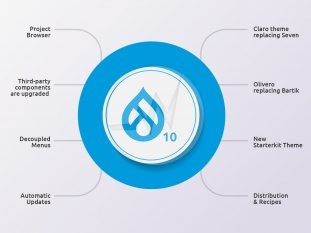
Drupal 7 Integrates Modules to Open Source CMS
The latest version of the Drupal content management system, integrates several popular modules that were previously separate from the core system.
The Obama administration has been by far the most aggressive adopters of open source technology compared to previous administrations. One of those open source tools has been the Drupal content management system (CMS), used to run the Whitehouse.gov site. It's a system that's also proved popular among a growing number of startups, smaller companies and enterprises.
Now, as Developer.com reports, the company behind Drupal has unveiled a new version that integrates what used to be separate modules and adds new Semantic Web features.
Open Source content management system users are getting a New Year's present this week with the release of Drupal 7. Drupal has become increasing popular in recent years with enterprise, consumer and government websites. The new Obama-era Whitehouse.gov uses Drupal and the FCC is set to adopt the open source technology as well.
The latest release of Drupal comes after three years of development. With Drupal 7, developers have added multiple improvements to the user, developer and enterprise experience.
Cloud IT a $1.6B Business in 2011: IDC
The research firm has a rosy forecast for network equipment revenues driving deployments of both public and private cloud in the coming year.
Cloud computing was one of the big buzz words of 2010 and IT interest in the technology is likely to grow even further in 2011 as enterprises look to reduce the cost and space traditional IT infrastructure requires.
Where will the growth be? A just-released IDC forecast indicates where the network equipment and other hardware sales are likely to have the greatest impact. And even though some market segments, such as highly regulated industries, will be less willing to trust a cloud provider, IDC says the pressure to reduce cost will encourage adoption. Enterprise Networking Today has the details.
The cloud will be discussed everywhere in 2011, but how much money actually is there in the cloud business? In a live webcast event this week, analyst firm IDC's Research Vice-President Cindy Borovick forecast a $1.6 billion cloud market in 2011.
Borovick's forecast is not for the entire cloud services ecosystem, but rather is a subset of IDC's data center and networking forecast. The $1.6 billion figure is IDC's projection for network equipment revenues used to power both public and private cloud deployments in 2011.
3 Reasons to Not Write Custom Code for SharePoint 2010
SharePoint Can Do Many Things
SharePoint 2010 is a product of considerable size. It's feature set is split into six separate areas by Microsoft. These areas cover social networking, communities and collaboration, search, business intelligence and much much more. In short SharePoint is a behemoth of a tool.
SharePoint is at heart an enterprise content management system, suitable for a wide range of uses, though it isn't suitable for all projects and implementations. Many clients come to me expecting it to replace a custom web application. They look to InfoPath forms and list based storage as a way of replacing a SQL server data store and custom screen designs - this is not what SharePoint is designed for. But for Intranet, Extranet or website applications, SharePoint can be pushed and molded into a variety of uses.
Supporting the SharePoint ecosystem are a wide range of third party companies and service providers. Some of these companies offer just basic single web parts; others like Nintex offer significant upgrades to built in functionality. But generally speaking your clients won't be facing totally unique problems each time, and someone else may well have solved the issues already and packaged it up nicely for reuse.
Writing Custom Code is a Mistake
This combination of core product and supporting tools offers clients a very capable CMS platform. So what do many SharePoint vendors go and do during the implementation phase? They litter their solutions with custom code. Custom code to change branding, tweak controls or extend functionality. Custom code to solve basic problems, or get around some of SharePoint's nuances. This is a tragic waste of time and money, for 3 very clear reasons.
1. There's Plenty of Functionality OTB
SharePoint offers so much functionality out of the box that time and time again people fail to make full use of what is on offer. It often appears easier to write some custom code to solve a problem, rather than investing the time to learn the ins and outs of the product. SharePoint gives users a whole box of building blocks to play with. But it does take someone with a real knowledge and understanding of the product to know how to use these blocks effectively.
Paying for features, and then not using them is never a wise use of IT spend. Instead clients and vendors should invest in training to enable staff to be able to make full use of the available feature set.
2. Writing Custom Code is Not Easy
Sure, lots of Microsoft partners have very capable development teams. And there is huge support for the .NET development environment from both Microsoft and the online community. But writing new code is inherently difficult. It needs designing, coding up, testing, testing again and then user testing.
Not only do you need to write the code, but you will then be expected to support and maintain it. Documentation will need to be written, and handovers carried out as staff turn over. Why go to this bother when you could solve 75% of a problem using out of the box features? Features that have been coded using another developer's blood and tears, and are supported by enterprise agreements and support plans.
3. Your Code Has a Shelf Life
Now this does apply to third party applications as well, but any code you write may well be limited to the current version of SharePoint. Your investment in custom code will disappear when SharePoint 2012 hits the shelves. Your clients are likely to expect an 'upgrade' of your code as well as their SharePoint installation. You did cost that into the project didn't you?
Make Sure Custom Code is Necessary
So next time you fire up Visual Studio on your SharePoint project think twice. Are you sure you can't solve the problem another way? Are you sure that MySites, the content query web part, or views can't help? Because if they can, I guarantee it will benefit both you and your client in the long run.
Now Showing: Longer YouTube Videos
Google's YouTube is opening up to much longer videos. Back in July, YouTube expanded the maximum upload time to 15 minutes, but today the video site announced a much longer length of time for select users.
"So go find that movie you wrote and filmed last year and share it with the world! Or upload your son's championship high school basketball game or the insightful lecture you just gave on the emerging economics of green tech. As long as it's your original content, it's fair game regardless of length," YouTube said in a blog post announcing the change.
Hollywood studios and others have sued YouTube over charges of copyright infringement leading the company to develop and deploy a number of copyright protection schemes. In today's announcement, YouTube was careful to note that the longer video uploads will only be available to "selected users with a history of complying with the YouTube Community Guidelines and our copyright rules."
Analyst Tim Bajarin said the expansion is a smart move by YouTube that opens up potentially new revenue streams.
"This could spur another growth in YouTube's business model as longer videos mean more potential advertising opportunities," Bajarin, principal analyst at Creative Strategies, told InternetNews.com. "There is also greater opportunity for more targeted ads, like a music store advertising on a guitar video."
Google, which bought YouTube in 2006 for $1.65 billion, has refused to say whether the video sharing site is profitable, but has said it's happy with the site's progress. During an earnings call with analysts in October, Google said YouTube is monetizing more than 2 billion views each week, up 50 percent from a year earlier.
A bigger distraction in the enterprise?
Bajarin said the longer videos are a mixed blessing for IT. On the one hand, it gives companies an easier way to broadcast things like executive speeches, reports and training videos to employees. On the other hand, entertainment and other non-work-related videos can be a distraction and impact employee productivity.
"But that's not just YouTube, that's part of the broader issue of how to manage streaming media in general that can bring networks to a crawl and the guidelines companies choose to enforce about social media, video and things of that nature," he said. "Of course the Cisco's of the world love anything that encourages longer video and greater network traffic because that increases the demand for their routers and switches."
YouTube credited advances to its Content ID system and other tools it provides copyright owners for enabling longer form videos. The company said over 1,000 partners use Content ID to manage their content on YouTube, including every major U.S. movie studio and music label.
5 Smart Ways to Find Clients
Finding clients is something almost every small business owner struggles with from time to time. There are many ways to do it, but it really boils down to putting yourself where your clients are, being approachable, and fulfilling a need or solving a problem for your potential clients. It doesn't have to be much more complicated than that.
The challenge is figuring out where to go and how to position yourself to get found by not just any client, but your ideal client. So the first step of the process is identifying your ideal client. Once you've done that, you can focus on getting yourself in front of those ideal clients. Here are a few ideas.
Market to Your Ideal Client
Once you know who your ideal client is, especially if you didn't have a clear picture before, you should take a good look at your marketing activities. Are you marketing to your specific type of ideal client, or are you trying to market to the masses? Consider working some new activities into your marketing plan that focus solely on putting your name where your ideal clients will see it. Explore advertising on websites frequented by your ideal clients, writing copy that feels more personal and relevant, and repeating some of your marketing messages in different ways to the same group of desirable clients.
Make Yourself Visible
While you may be going out and actively searching for clients, imagine if your ideal clients came to you on their own? Some of the ways you can make yourself a client magnet are by optimizing your website and blog, participating in industry groups, commenting on relevant blogs, and being active and consistent (and interacting) in social media.
Become a Local Networker
Many times, when we conduct so much of our business online, we hesitate to cross back over to the "real world." But there can be a tremendous amount of value in working with local clients. If you haven't explored your local area, consider joining local industry organizations, speaking at non-industry events, and offering live classes, seminars and question and answer sessions for people outside of your industry.
Maximize Referrals and Recommendations
Once you have a few clients who fit into your ideal client sketch, a significant portion of your attention should be focused on keeping them happy and exploring how you can do more to support them. Then, ask for referrals and recommendations. In many cases, your ideal clients will have colleagues who are just like them, expanding your potential client pool significantly.
Explore a Joint Venture
The power of numbers can't be ignored, especially when it comes to finding clients. If you have a colleague who offers complementary but not competitive services, consider teaming up to expand your reach. There is a lot you can do in a joint venture that can increase business, from bundling services, to email marketing, to offering added value and incentives.
Joomla's Open Source CMS Has Enterprise Appeal
The new version 1.6 of Joomla's content management system has several enterprise-friendly features.
It's been a long wait, but after three years in development, Joomla 1.6, the latest version of the open source content management system (CMS), is out.
Enterprise users may find several features of interest in the new release including a new abstraction layer that further enables the CMS to run on different database backends as well as leaving the door open to future innovation. Joomla 1.6 also improves the enterprise usability of the open source project with enhanced access control. Joomla is among the three most popular open source CMS systems, including Wordpress 3 and Drupal 7 and both of those recently released updates of their own.
"There wasn't a specific charge to make Joomla 1.6 enterprise ready, but there was a good understanding that there were key features under the hood that were necessary for larger scale or more complex installations," Ryan Ozimek, president of Open Source Matters the non-profit group that runs the Joomla project told InternetNews.com. "One of the key things is the implementation of a robust Access Control List (ACL)."
Ozimek also noted that the Joomla platform project can potentially be the glue used by an enterprise to tie different Web services together and provide customized services. Read the DevX story for more key details about the new release.
Firefox 4 To Arrive in February
Mozilla had planned to ship the latest version of its popular browser by November, 2010, but too many bugs remained to release a final candidate. According to Sicore, Flash, Silverlight and "other major plug-ins" were continuing to cause problems, with users "affected by hardware acceleration causing crashes or other issues." According to PCWorld, Sicore said that "about 160 'hard blockers'--or significant bugs--remain in the project."
Hardware acceleration is one of the key features boasted by Microsoft to boost Internet Explorer 9 ahead of other browsers. Currently, Firefox is second in popularity worldwide only to Internet Explorer, with Chrome and Safari following behind.
For a full look at what to expect in the latest version of Firefox, take a look at Frederic Lardinois' in-depth review from earlier this year. The long and short of it is that the next version will be faster, sleeker, with "do not track" capabilities to enhance user privacy.
DownloadSquad points out that, if you want to help Firefox along, you can take part in beta testing the product by downloading the latest version and reporting any bugs you come across.
What do you think? Will you try out Firefox 4? Is that your browser of choice or will Chrome keep your attention? Or has IE9 brought you back to the Microsoft side?
5 Ways to Make Twitter Less Noisy
One of the biggest criticisms about Twitter among all types of users is the noise. And it's bound to get noisier as Twitter gets more and more popular.
The good news is that there are a number of ways available to help you control the noise, find the information that's most important to you and ignore the rest. Here are five ideas that can help you turn down the volume on Twitter.
Use a Social Media Management Tool
Once you build up a healthy following, your Twitter stream can get crowded and noisy. It can be difficult to find the information you want, facilitate the conversations that are important to you, and maximize your use of Twitter without some sort of management tool.
There are hundreds of such tools out there, all with varying features and functions. The right social media management tool depends on your individual needs. If you are just starting to explore using a management tool, some of the most popular options include Hootsuite, Tweetdeck and SocialOomph.
Create Twitter Lists
Twitter Lists are very useful for grouping, labeling and focusing on specific accounts you want to keep tabs on in Twitter, without the noise of a regular Twitter stream. They can be very useful if you use the web-based Twitter client or even if you use a social media management tool.
You can set up your Lists right on Twitter, and there are also Twitter List apps that help you maximize your use of the functionality, including Formulists, ListAtlas and the apps listed here.
Unfollow
One easy way to cut through the Twitter noise is by unfollowing anyone you don't want to communicate with on a regular basis. There are a number of tools to help you do this quickly and relatively easily, including Friend of Follow, Tweet Spinner and SocialToo. Just a word of caution that mass unfollowing may cause you to lose some followers.
Use a Muting App
This is a handy way to temporarily turn down the Twitter noise from people you typically enjoy following. For example, let's say a few of the people you follow are at a conference and are live-tweeting the event, and you just aren't interested. You can "mute" their accounts until the event ends and they have returned to their normal tweeting. Two services that do this are Muuter and Twalala.
Run a Targeted Search
There are a lot of Twitter search apps, in addition to Twitter Search, that can help you wade through the noise and find exactly the information you want. Two targeted search apps are tweetzi, a real-time Twitter search tool, and Twippr, a twitter search engine that looks only into friends' tweets.
Google answers critics on HTML5 Web video move
Google responded to critics of its decision to drop support for a popular HTML5 video codec by declaring that a royalty-supported standard for Web video will hold the Web hostage.
Much has been made last week of Google's decision to end support for the widely used H.264 video codec as it implements a key portion of the collection of technologies known as HTML5 in its Chrome browser. Mike Jazayeri, a product manager for Google, wrote a blog post last week responding to some of the more common critiques of its plan to support only the WebM video codec standard within the <video> tag.
"Our choice was to make a decision today and invest in open technology to move the platform forward, or to accept the status quo of a fragmented platform where the pace of innovation may be clouded by the interests of those collecting royalties," Jazayeri wrote. "Seen in this light, we are choosing to bet on the open web and are confident this decision will spur innovation that benefits users and the industry."
Google's decision to support WebM only splits the browser community roughly in two. Apple and Microsoft support the H.264 codec as the technology to be used in the
The main issue is that the five organizations involved in the HTML5 standards-setting process were simply not going to agree on a standard codec for the <video> tag, Jazayeri wrote. Apple and Microsoft are members of the patent pool that licenses the H.264 code, known as MPEG-LA. And Mozilla and Opera are smaller organizations opposed to paying the licensing fees for that technology.
"To companies like Google, the license fees may not be material, but to the next great video startup and those in emerging markets these fees stifle innovation," Jazayeri wrote in the post. "We believe the web will suffer if there isn't a truly open, rapidly evolving, community developed alternative and have made significant investments to ensure there is one."
Google's decision has caused consternation among video producers worried about having to support two different video standards, since they have no choice but to support devices that play H.264 video--nearly all modern devices--for years to come. Hardware decoders for the H.264 codec, which are all but essential for mobile devices with constrained battery life, are widespread while hardware decoders for WebM are just now emerging.
Critics have also pointed out that the decision might actually cause video sites to rely on plug-ins to display video when the whole point of the
Google, with a huge repository of video in YouTube, understands the concerns about maintaining two different video standards, Jazayeri wrote. However, they were probably going to have to do so anyway if they wanted to serve video to Firefox users, who constitute roughly 22 percent of the market, he wrote. (Opera's market share is around 2 percent.)
Jazayeri did not directly address the issue of Google's support for WebM ensuring Flash would live for years, other than to say that Chrome would continue to support that plug-in.
The post is likely to do nothing to mollify those who think Google is making a huge mistake, but it does lay out the company's thinking in a much more detailed way than its original post provided.
"Bottom line, we are at an impasse in the evolution of HTML video," Jazayeri wrote. "This is why we're joining others in the community to invest in WebM and encouraging every browser vendor to adopt it for the emerging HTML video platform (the WebM Project team will soon release plugins that enable WebM support in Safari and IE9)."
Video: Getting Started with Object-Oriented PHP
Although PHP wasn't conceived as an object-oriented language, its soaring popularity in the years following its initial release caused the developers to reconsider this decision. The decision to add object-oriented features in later releases was made in order to provider users with more sophisticated options for managing larger and more complex applications. However, to this day PHP remains a hybridized language, allowing both procedural and object-oriented programming. This flexibility has largely been a net positive because novice programmers generally find PHP to be the least intimidating of today's mainstream languages.
However, any novice programmer intent on building and maintaining a relatively complex PHP-driven website will almost certainly want to use a framework such as the Zend Framework, symfony or CakePHP. Because these frameworks are all object-oriented, developers lacking basic knowledge of PHP's object-oriented syntax will find themselves at a serious disadvantage. There's nothing to worry about though, as the syntax is every bit as straightforward as the rest of the language!
In the first of a two-part video series, you'll be introduced to PHP's object-oriented syntax, learning how to create a class, and populate it with class attributes and methods. You'll also learn how to access and manipulate object data, and create a constructor useful for initializing class data.
Facebook, Google and Yahoo to test new IP in June
Google, Facebook and Yahoo have announced that they will be participating in a 24-hour test of IPv6 on 8 June.
By the end of 2011, it has been forecast that the internet will run out of space using its current 32-bit IPv4 address format.
The IPv4 format has been in place for over thirty years, since the very dawn of the web, but the new IPv6 solution will support more web addresses than its predecessor; a total of 3.4 followed by 38 zeros, to be precise.
Hardly room to swing a cat
Although some sites, including the Google-owned YouTube, currently use the new standard, IPv6 has never been used on such a wide scale before.
Google doesn't anticipate many issues though. The illustrious search giant said in a blog post, "The good news is that Internet users don't need to do anything special to prepare for World IPv6 Day. Our current measurements suggest that the vast majority (99.95%) of users will be unaffected.
"However, in rare cases, users may experience connectivity problems, often due to misconfigured or misbehaving home network devices. Over the coming months we will be working with application developers, operating system vendors and network device manufacturers to further minimize the impact and provide testing tools and advice for users."
What New on Adobe Creative Suit 5
Software is often gotten significant improvement from time to time and it is also true that the improvement sometime comes from the users. Similarly, Adobe also improves the software called Adobe Creative Suite 5. Thus, throughout this article, there are some improvements given to this software which surely provide more functions and benefits.
Adobe Creative Suite 5 offers the latest feature that is Design Standard. It seems like the basic package that comes with something more useful for printing job. To get more power, you can opt for Design Premium that is already equipped with adds tools for building websites as well as other internet apps. After finishing your job and you need to print it, the Web Premium can cover your need and this is not the old traditional print app.
Through Web Premium, producing animation and other interactive content is just an easy work to do. Moreover, the Production Premium is advanced with film, video, and audio, also there are options of different ways to edit and intercut all three.
Adobe Creative Suit 5 comes with many benefits because it offers more than one app. The additional apps can be made use for multiple programs. This improved software provides you more like you can now back and forth between the vector graphic editor, and illustrator at ease, also the latest design-oriented animation maker like Flash Catalyst.
If you need to create everything in the full-fledged app designer, the Flash Professional can easily incorporate into InDesign projects that remove the boundaries between print and the Web.
Apparently, the ability to help you to find what you exactly need for any program is still around because of Adobe Bridge is there to help you. This feature proffers the same functionality in a panel that keeps you stay focus on the app you are using. This way, you can get full control over your default layouts and any changes you want to apply to them.
More importantly, CS5 is upgraded with more connections like new CS Live online services. Also CS5 packs CS Review so you can open any document like Photoshop, Illustrator, and InDesign. Even your colleagues will be able to view and comment non-destructively online.
One feature that should make many web designers impressed is the adorable BrowserLab that allows you to preview sites and test local content through many different web browsers, whereas Adobe Story helps you to produce and monetize the videos through Production Premium apps.
Debug Faster with F12 Developer Tools in Internet Explorer 9
Can you imagine building and debugging a website's code without the assistance of some kind of integrated development and debugging tools? For those of us who have been developing sites and web apps for more than a few years, we don't have to imagine that-it was a reality we dealt with on a regular basis.
But times have changed. The heavy demands and responsibility placed on web developers today have necessitated the rise of developer tools in all modern browsers.
With the release of IE9 Beta and its built-in F12 Developer Tools, the IE team has advanced on its commitment to helping developers debug their front-end code quickly and improve site performance.
some of the most important features of IE9's F12 Developer Tools, with a particular focus on what's new and what's most practical:
- Network Inspection Tab
- Inspecting HTML and CSS
- Script Debugging and Using the Console
- Improving Script Performance
- Changing the UA String and Compatibility Modes
- Putting it Together
5 of the Best Browser-Based Font Viewers
You probably have several hundred fonts installed on your PC. Windows, Mac OS and Linux install a wide variety and you may have purchased or downloaded free fonts. If you're like me, you'll regularly browse font foundry websites when you need to create a new logo or title . but you'll still end up using a font that's installed on your PC.
Unfortunately, the font viewing applications supplied with most operating systems are basic. There are a few commercial and open source viewers, but many are clunky or won't necessary run on your system. Fortunately, there are several browser-based alternatives which can preview your installed fonts.
myFontBook was one of the first browser-based font viewers and it remains the best. Fonts can be previewed in a list or table format, printed, tagged or rated. You can use the application without registering but, if you do, your data is saved between sessions.
myFontBook offers more features than the competition. The only drawbacks are that it can be a little slow to start and you need to click a font to view custom text.
wordmark.it is the first site you should visit when creating your next logo. The interface is simple: the text you enter is previewed in every font. You can select and filter any number of fonts for a direct side-by-side comparison.
wordmark.it may not have the features of myFontBook, but it's fast and functional.
flippingtypical.com is the only font viewer in this list which doesn't rely on Flash. It should therefore work on your iPhone or iPad without problems.
The interface is similar to wordmark.it but it's even faster. The main drawback is the database of font names flippingtypical.com uses: it can never be a fully comprehensive list so it won't find all the fonts you've installed. On my PC, it located just 72 out of more than 400 fonts. That said, it remains a useful system for quick browsing.
Font Picker is one of the simpler tools in this list, but don't let that put you off. Like wordmark.it and flippingtypical.com, you are presented with a list of fonts showing your custom text. You can then remove fonts by clicking the 'X' icon so a set of appropriate styles can be compared.
Unlike the tools above, STC FontBrowser is a full Flash application which was originally released in 2003. It's very similar to a desktop-based tool.
Font browsing is fast since you're only shown a list of all system fonts in plain text. You can click a font to see the preview text in that style. It's an ideal application if you've already selected a font and want to experiment with longer text strings and multiple sizes.
Security Expert Warns of Widget Malware
Widgets, a popular vehicle for advertising and Web content, can also be used to distribute malware, according to Dasient CTO Neil Daswani, who took his message to Black Hat this week.
Widgets may be fun and convenient vessels for spreading content and ads on the Web, but there's a sinister side to them, according to Neil Daswani, the CTO and co-founder of Dasient.
Daswani took his message to the Black Hat security conference in Washington this week, where he delivered a presentation outlining the vulnerabilities of widgets, warning website owners to defend against their content becoming a vehicle for delivering malware.
"Ad widgets, when compromised, can be used to spread mass malware infections across the most highly trafficked websites on the Internet," Daswani said.
Among the most targeted widgets are those associated with audience measurement from services like Google analytics, and widgets built on third-party APIs from Google and Facebook.
Java, .NET Get Competition From Scala Parallel Programming Language
Scala is not among the most popular programming languages but soon this could change. With a EUR 2.3 million grant from the European Research Council (ERC), the Scala team will double their efforts to produce a parallel programming language for wider use.
Why Did Scala Get the EU Grant?
The short answer is because Scala's proposal was good and the ERC was convinced that this project deserves to be awarded the 5 year, EUR2.3 million grant in the Popular Parallel Programming challenge.
The attention that Popular Parallel Programming (PPP) gets from ERC stems from the Council's view that PPP is "the single most important problem facing the global IT industry. Without significant progress, there is a considerable risk that the underlying business model, in which hardware performance developments enable improved software which drives purchases of new hardware, will be broken."
Scala was one of the applicants for the grant and it was the lucky one to be picked. Scala is a general purpose parallel programming language and it can be used for many purposes, including for writing applications for the cloud. Without delving into the technical details, the benefits of a parallel programming language in regards to enterprise software is that it simplifies programming a lot. If you are interested in the technical details around Scala, you can read the synopsis of their proposal.
What Will Be Benefit for the Community
If you are not familiar with Scala maybe you are just wondering what the benefit for the community will be. Among other things, cloud applications will also benefit from parallel programming, so Scala could be used to optimize cloud applications as well.
Scala is an open source language. It is a functional, object-oriented programming language and it has a lot in common with Java and .NET. The similarity with the two most popular languages is an asset because it will help its adoption by developers and organizations - they won't need to start learning it from scratch.
Scala doesn't invent the wheel - it just improves on it. As the developers of Scala put it, "The principal innovation is to use "language virtualization", combining polymorphic embeddings with domain-specific optimizations in a staged compilation process."
Scala sounds like an ambitious project and it is good that the ERC provided the funding. The funding will be used mainly for the definition of domain-specific languages (DSLs) in libraries and it is not sufficient to cover the whole development cycle. Still it is help and as such it is appreciated.
It is good that EU gives grants to outstanding projects because this helps to develop technologies that otherwise would be next to impossible to create because they are not commercial in nature and they can't generate enough revenue for the company that develops them.
Oracle Gives WebCenter Suite 11g Major Refresh
Database giant begins shipping latest version of Fusion middleware component, promising a significant new array of collaboration and social applications.
Oracle is looking to add a new page to the playbook for enterprise applications, shipping what it touts as a major update to its WebCenter Suite 11g.
With the new version, Oracle is combining elements from its various portal offerings, promising "a comprehensive, modern enterprise 2.0 platform."
"[The suite] enables organizations to develop and deploy internal and external portals and websites, composite applications, mashups, and social and collaboration services all tightly integrated with enterprise applications," an Oracle spokesman said.
The new version is intended to significantly streamline the process of developing Fusion middleware applications, and supports the Content Management Interoperability Standard.
HTML5 is Dead. Long Live HTML.
The Web Hypertext Applications Technology Working Group (WHATWG) - the organization which instigated HTML5 - has announced they are dropping version numbers. HTML5 is complete. The new standard is simply "HTML."
The announcement was made by specification editor Ian Hickson. His blog post states that the HTML standard has become a living document:
The specification will be known as "HTML" with the URL whatwg.org/html.
The WHATWG HTML specification can now be considered a "living standard." It's more mature than any version of the HTML specification to date, so it makes little sense to refer to it as a "draft." The snapshot model of specification development has been abandoned.
What About the W3C?
The WHATWG announcement came two days after the W3C launched their HTML5 logo.
The term "HTML5" is unlikely to disappear since the W3C standards approval process is structured around a progression of version-numbered technology specifications. Currently, the W3C remains committed to HTML5 and they won't necessarily follow WHATWG's lead.
However, the new logo has muddied the waters, and the W3C appears to be lumping CSS3, SVG and JavaScript APIs under the HTML5 "brand." Although they've backtracked a little on their logo FAQ, it's becoming increasingly difficult to refer to HTML5 as a specific technology when its own standards body has jumped on the marketing bandwagon.
Amazon Web Services Launches Bulk Email Effort
AWS today launched a bulk e-mailer for businesses. Dubbed the Simple Email Service (SES), Amazon's latest offering eliminates the need for an in-house e-mail solution, or the licensing, installing, and operating of a third-party tool.
In addition to cutting out a lot of extra fat, SES integrates with other AWS services, making it simple to send e-mails from applications hosted on services such as Amazon EC2.
As far as pricing goes, Amazon will charge fees for the number of e-mails sent plus data transfers. Pricing for SES is US$ 0.10 per thousand messages sent. A customer may also send 2,000 e-mail messages per day free of charge when these e-mails originate from Amazon EC2 or AWS Elastic Beanstalk.
Step By Step
To get started, Amazon requires a few steps:
Subscribe: After signing up for Amazon SES, you can access the Amazon SES sandbox.
Verify Email Addresses: To verify an e-mail address, make an API call with the e-mail address as a parameter. This API call will trigger a verification email, which will contain a link that you can click on to complete the verification process.
Request Production Access: Requesting production access will allow you to move from the sandbox environment to the production environment.
Send Email: Amazon SES has two different APIs for queuing an e-mail message for delivery. The first allows you to specify the components of a message for an SMTP-compliant email message; the second enables you to send a raw message, and specify your own email headers and MIME types.
Once you've gotten into the groove of things, gauge how well you're doing. Amazon SES provides the ability to view statistics about your sending activities such as volume sent, bounces and complaints.
Microsoft Issues New Zero-Day Security Advisory
The software giant said the vulnerability is common to all versions of Windows.
Who's ahead in Windows security, the good guys or the bad guys? The software giant has invested considerable resources in trying to anticipate new and emerging threats and its latest security advisory is another attempt to get ahead of the curve.
The vulnerability takes advantage of a common method of transferring media types in email messages.
The hole, called the MHTML protocol handler, is located in a part of all supported versions of Windows, including XP Service Pack 3. By luring a user to visit a malicious site and click on a booby-trapped link, an attack program could send the handler a poisoned script.
Microsoft said the result of a successful attack on a user would only be to enable "unintended information disclosure" -- rather than compromise the entire system.
Earlier this month, Microsoft had one of its lighter Patch Tuesdays, releasing only three fixes after several months of larger patch releases.
eSecurity Planet details the latest security advisory including a workaround Microsoft is suggesting to head off the security threat. Microsoft also said it was working with service provider "for possible ways that they can take steps to provide protection on the server side."
LinkedIn files for IPO
LinkedIn has formally announced its plans to go public through the filing of an S-1 form with the U.S. Securities and Exchange Commission Friday, making it the first time that the business networking site has turned over many of the detailed facts about its financial operations.
"We believe we are transforming the way people work by connecting talent with opportunity at massive scale," LinkedIn explained in its filing. "Our goal is to provide a global platform capable of mapping every professional's experience, skills, and other relevant professional data to his or her professional graph, including connections with colleagues and business contacts."
Through a combination of advertising and business services, LinkedIn has managed to actually make some money in the process. Net revenue in the first nine months of 2010 was US$161 million, with a profit of US$10 million; in the same period in the previous year, it logged half that revenue and only US$3.4 million in profit.
LinkedIn has more than 90 million registered members, up from 55 million a year before--a statistic that it's been more vocal about as a private company. But in the S-1 filing, the company warned that not all of its registered users are active and that a minority of members are responsible for the "substantial" majority of its 5.5 billion page views.
Google Docs Update Enhances Access to Content
The search giant makes it easier to organize, retrieve and share content from its cloud-based Google Docs system.
Google Apps users sometimes wrestle with the same problems as users of Google's popular search engine -- how to quickly find the most relevant information.
To be sure, in the past few years Google (NASDAQ: GOOG) and its search competitors have added features to present users with the most relevant results at the top of the page. The company has also added relevancy features to its Gmail email service, giving users the option to view a Priority inbox that ranks emails based on their likely importance.
About a year ago, Google (NASDAQ: GOOG) gave Docs users the ability to upload, store and share any file in the Google Docs cloud so that they are then available wherever the user happens to log into Google Apps. In a blog post today, Google introduced a refresh to Google Docs that's designed to help users better organize the number and variety of files they can access in one place.
For example, Google Docs now has several filters designed to help users narrow a search by file type, visibility state and other criteria.
Read Datamation's report on the new features including a Priority feature that has a few things in common with an earlier update to Gmail.
LibreOffice 3.3 Frees Open Source Office Suite
The Document Foundation today announced the official release of LibreOffice 3.3, a fork of Oracle's Open Office open source office suite. The LibreOffice project began in September 2010 with the backing of the major Linux distributions, including Novell SUSE, Red Hat and Canonical Ubuntu. The LibreOffice 3.3 release follows Oracle's Open Office 3.3, which came out in December. While LibreOffice 3.3 has its roots in Open Office 3.3, there a number of key differences, including an improved Windows installer.
"For Windows users, there are a lot of big wins," Michael Meeks, distinguished engineer at Novell, told InternetNews.com. "We've bundled a number of extensions for Windows that are particularly useful that people wouldn't have downloaded from the extensions repository."
Meeks added that the new Windows installer also bundles 55 languages, which are now well supported.
"That contrasts with Open Office, which previously shipped 160 MB files in 55 different languages and we ship one 210 MB file with all the languages," Meeks said.
Overall, the key differences between LibreOffice 3.3 and Open Office 3.3 that Meeks cited boil down to a long list of bug fixes. He noted that bug fixes have been made all over the place to fix flaws big and small. And those changes are not all necessarily being contributed back to Oracle's Open Office.
"It's up to each contributor as to where the changes go, but typically the changes are going straight into LibreOffice and being contributed over to Oracle," Meeks said. "These changes and fixes are specific to LibreOffice."
Among the bug fixes in LibreOffice are memory and startup issues that could end up serving to improve performance. Meeks noted that a contribution from Red Hat made a number of fixes to improve memory management in LibreOffice.
What to Include In Your Marketing Plan
I covered business plans and four of the most important elements to include in an abbreviated version. The same shorter process can be applied to another powerful type of planning - marketing. Here are some of the most important parts of a marketing plan that can be used for a new business or any business.
Target Market
You can't target everyone and expect to be successful; it's impossible. You need to have an idea of your ideal clients or customers, then you need to do some market research to find out everything you can about them. This section should answer: Who are you targeting, specifically? What will they do, where will they live, what challenges will they have, where will you find them?
Positioning Statement
Your unique positioning statement is what will set you apart from the competition and provide clarity about how you want to present your products and services throughout your marketing copy. Answer the question: What does your business do better than anyone else can?
Value
Now that you know what makes you unique, consider what will make your target clients decide to pick you over your competition. What value will you offer your target clients that they can't get anywhere else? What will make them think the value they're receiving surpasses the financial investment required?
Goals
Going back to the goals you outlined in your business planning, create marketing goals that match up. What will you need to achieve through your marketing activities that will help you reach your overall business goals?
Pricing Strategy
This section could fit into your abbreviated business plan, but I personally like it kept in the marketing plan since the strategy you select will play a very significant role in how you create your marketing messages. Answer: What you will charge for your products/services? Why did you select that price point? What variations will you have on your standard pricing (coupons, discounts, etc.)?
SWOT Analysis
A SWOT analysis in an opportunity for you to identify not only your own strengths, weaknesses, opportunities and threats, but also that of your competition. The data you uncover can help you identify an untapped niche, formulate ideas for improving your marketing message and open your eyes to what your competition is doing.
Budget and Planning
Your marketing budget plays a big role in how you will execute your marketing plan. In this section, outline what you intend to spend on marketing each month, then break down the actual actions you will take. This can be expanded into a dedicated marketing action list that you refer to on an ongoing basis.
The good news is, you can create an effective marketing campaign, even with a small marketing budget. It all starts with the plan which you've already started here; add a little creativity and you may come up with some very effective ways to put your marketing plan into action.
Facebook launches new low-tech mobile site
Much of Facebook's projected growth over the next few years is in regions of the world where an iPhone or Android device is a novelty rather than a staple. Consequently, the company has been making some strategic moves: On Wednesday, Facebook announced a new mobile site optimized for lower-end cell phones and a plan to make it available in many countries without data fees.
"The app provides a better Facebook experience for our most popular features, including an easier-to-navigate home screen, contact synchronization, and fast scrolling of photos and friend updates," explained a blog post by Mark Heynen, a program manager at Facebook.
Developed in partnership with Snaptu, a mobile development company, the new Facebook site works on more than 2,500 cell phones from the likes of Nokia, Sony Ericsson, and LG. The company has also inked agreements with carriers in countries as varied as Brazil, Canada, Tunisia, Romania, and Hong Kong (currently, none are in the U.S.) to make access to the site free of data charges for 90 days to start. More agreements are on the way, including potentially extended no-fee plans.
This appears to be putting a more official face to a project that Facebook has been working on for some time, launching ephemeral experiments like Facebook Lite for easier access to the social network from slower connections and more low-tech browsers. It's kept around a more basic mobile site, 0.facebook.com.
Facebook's mobile initiatives made headlines last year when the company was rumored to be developing a mobile phone or operating system of its own, something that it has obliquely denied.
Google Targets Education With New Apps Section
Search giant builds on established partnerships with schools and universities to develop a separate category for education applications in its Apps Marketplace.
Google has forged numerous partnerships with various schools and universities over its brief history, and it is continuing to promote the use of technology in the sector with the launch of a new section of its population Apps Marketplace designed for education.
New apps in the Education section range from teaching aids to learning management systems, and Google is hoping the store will grow rapidly.
"We are very optimistic that schools and developers will see the exciting benefits of a centralized storefront of integrated web-apps," said a Google spokesman.
The store also features applications geared for students, such as the EasyBib offering, which helps students quickly develop properly formatted bibliographies.
Hotmail Adds Support for Multiple Aliases
Microsoft gives users of its free online email system "aliases" so that they can have disposable email addresses.
Microsoft has released an update to Windows Live Hotmail that adds the ability to have multiple email aliases, a practice that many users follow on the Web.
For instance, that would let a user have a separate email address to give out to someone he or she met at a party, or to give to companies that might may later sell the address to spammers.
"Starting today, you can create and manage multiple email aliases from a single Hotmail account," Dharmesh Mehta, director of Windows Live product management, said in a post to the Inside Windows Live blog
"The average person maintains three different email addresses in order to organize different types of email, maintain different personas or keep junk mail away from a primary email address," he said. The way to do this is to use an alias, or alternate identity -- a different email address than the user's true address.
"Email aliases let you create completely different email addresses that you can use to receive email into your primary account without anyone knowing what your primary email address is," Mehta added.
If, for example, a user gave out an alias that got incorporated into a spammer's list, it would be easy enough to simply delete that alias, giving those spam messages nowhere to go.
"There are many good reasons that people want multiple email addresses, but maintaining multiple accounts, with different user names and passwords that require you to check multiple inboxes, is inefficient," Mehta said.
Hotmail's new alias feature aims to simplify that.
The aliasing feature works with the Sweep function, which was added to Hotmail last year in order to make e-mail administration easier and faster.
Microsoft is not making the use of aliases unlimited, though -- a Hotmail user can add five aliases a year, up to a maximum total of 15.
Hackers Use Facebook Mania to Spread Malware
Facebook is a magnet for security threats and hackers are capitalizing on users' addiction to the social networking site to do even more damage.
A pair of new malware strains are making their way through the Facebook community this week, using different delivery methods but the same bait: follow these instructions or you won't be able to see who posted on your wall.
As eSecurity Planet reports, these new security threats are capable of turning your PC or smartphone into convenient spam-distribution devices and stealing enough personal information to access victims' online banking and other accounts.
Both scams, either delivered in an unsolicited email or instant message, threaten intended victims with the prospect of not being able to login or access their Facebook accounts.
Panda Security researchers identified the first new threat as Asprox.N, is a Trojan stashed away in an unsolicited email that advises users that their Facebook accounts are being used to send spam. When someone foolishly follows the hacker's deceptive directions, which include clicking on a faux Word document supposedly containing a new password, the victim's PC or mobile device is infected and becomes a vehicle for distributing spam.
The second threat, which is being spread across MSN and Yahoo instant messaging apps, displays a malicious link that, if clicked, infects users' computers or mobile devices with the Lolbot.Q worm.
Once the worm has installed and victims attempt to log in to Facebook, a message pops up informing users that their account has been suspended and, in order to reactive their account, they must fill out a questionnaire offering a chance to win a new laptop or iPad.
Zimbra 7 Release Has VMware's Imprint
Now owned by VMware, the latest release of Zimbra brings improved scalability, among other new features.
Remember Zimbra? The open source, email, calendar and collaboration software has had an interesting evolution from startup to its acquisition by Yahoo (NASDAQ: YHOO) and its later sale to current owner, VMware (NYSE: VMW) a little over a year ago. Zimbra 6, released in September, 2009, was the last major release of Zimbra.
The release of Zimbra 7 this week is the first under VMware's ownership and leverages some of the technology the virtualization leader is best known for. For example, Zimbra 7 features VMware virtualization-related enhancements as well as enhanced delegation capabilities to control permissions and access as well as new policies for load balancing and automatic recovery of Zimbra servers.
"Zimbra is a great example of the type of scalable 'cloud era' solutions that can span smaller, on-premise implementations to the cloud," said VMware vice president Brian Byun. "It will be a building block in an expanding portfolio of solutions that can be offered as a virtual appliance or by a cloud service provider."
ServerWatch details other features in Zimbra 7 and comments by another open source player, SugarCRM CEO Larry Augustin.
Microsoft IE9 Release Candidate a Breakthrough?
The software giant is touting advanced performance and privacy features in the latest release of the Internet Explorer 9 browser.
Microsoft continues to hold the biggest share of the market for Web browsers, but upstart competitors like Firefox and Google's Chrome have been steadily chipping away at its lead.
But Microsoft's (NASDAQ: MSFT) never been known to shy away from competition and browsers are no exception. The company has invested heavily in advancing the venerable Internet Explorer and showed off the fruits of if its efforts, IE9 Release Candidate (RC), here at a media event on Thursday.
The availability of the IE 9 RC means the final or RTW (Release to Web) version of IE9 isn't far off. While it's still accepting feedback from developers and users, the RC is considered feature complete with no significant changes expected in the RTW.
A number of improvements and new features were demoed by Microsoft and partners including user interface improvements, hardware acceleration tied to PCs running Windows 7 and expanded privacy controls.
The news comes as Microsoft is pushing hard to regain the market-leading IE's momentum in the face of competitors like Google's Chrome and Firefox.
"It's a battle Microsoft can't afford to lose because the browser is the gateway to the Web's present and future," Gartner analyst Ray Valdes told InternetNews.com. Check out the full report on Microsoft's IE9 announcement in Datamation.
Really Strategies Introduces Cloud Book Publishing and Workflow
Publishing content management provider Really Strategies has announced the availability of RSuite Cloud, a cloud-based print, web and eBook production solution that supports 70 languages. The product capitalizes on three of what are expected to be the biggest technology trends of 2011: Cloud computing, content management and globalization.
Publishing as a Cloud Service
RSuite Cloud is a hosted content management and publishing solution for publishers to create, manag, and distribute single-source content to multiple channels. The software-as-a-service product augments the company's existing on-premise RSuite publishing platform. Really Strategies representatives said,
We are excited about our ability to scale with this solution and the new scheduling flexibility that we could never have dreamed of in our old environment."
The cloud-based platform allows customers to ramp up content management and publishing capabilities without significant resource or financial investment.
RSuite Cloud integrates with Microsoft Word. Users can import documents into the system and convert the files to XML for web-based copyediting and automated page composition. The solution also supports production workflows to generate page proofs and eBook drafts for content review and approval. Rsuite is pre-configured to publish print-ready PDF files, HTML output and eBook formats.
Customers with a global audience will appreciate the platform's language translation tools. The system can publish in 70 languages, including all major European, Asian, and bidirectional languages, and supports content localization. Other features of the platform include:
- Browser-based editorial corrections
- Secure access and version control
- Search
- Production to multiple formats such as print, eBook readers, web and iPad
Existing users of the Rsuite platform should be aware that the product focus of the cloud platform is books, not all publishing products (such as journals, newsletters and magazines, for example) like previous offerings.
Getting the Cloud Publishing Solution
RSuite Cloud is available now. Really Strategies configures the system for customers and charges no initial setup fees. RSuite Cloud is available on a per-user license or pay-per-page model. The pay-per-page model allows customers to obtain the software free and pay for final pages published from the system. Users can publish unlimited PDF proofs with no proofing charges. The cost of publishing finalized pages starts at US$ 1 per page. Users can also create eBooks on the platform for US$ 100.
As in many other industries, we will see traditional publishing models affected by the emergence of flexible cloud-based solutions. Savvy publishers will incorporate the cloud into their publishing process to reduce costs and streamline their workflow processes for editors and authors.
Microsoft responds to Google's copycat claims, again
Following last week's fracas over whether Microsoft was culling search results from rival Google, Yusuf Mehdi, Microsoft's senior vice president of its Online Services Division, has weighed in, reiterating that Google's claims are false.
"We do not copy results from any of our competitors. Period. Full stop," Mehdi said in a post on Bing's community blog titled "Setting the record straight".
"We have some of the best minds in the world at work on search quality and relevance, and for a competitor to accuse any one of these people of such activity is just insulting," Mehdi said.
Mehdi went on to mirror some of the statements made by Harry Shum, Microsoft's head of core search development, during the company's Farsight event. Shum had discussed allegations on stage with Google's head of Web spam, Matt Cutts; Mehdi outlined how Bing made use of anonymous click stream data, along with "more than a thousand inputs" to create Bing's ranking algorithm.
Mehdi said that Google's plan to check whether Bing was looking at that click stream data was "rigged to manipulate Bing search results", and called Google's honeypot attack "click fraud". He then compared Google's efforts to the the methods used by spammers to create fraudulent search result pages.
"What does all this cloak and dagger click fraud prove? Nothing anyone in the industry doesn't already know," Mehdi said. "As we have said before and again in this post, we use click stream optionally provided by consumers in an anonymous fashion as one of 1,000 signals to try and determine whether a site might make sense to be in our index."
Mehdi closed up the post by saying that the company would continue to focus on innovating the product, though added a jab about the timing of Google's honeypot discovery, saying it was directly related to some of Microsoft's recent improvements to Bing, which were "so big and noticeable that we are told Google took notice and began to worry," Mehdi said.
Flash 10.2 coming to mobile, better battery life
Flash Player 10.2 has only been available for Windows and Mac for a few days but it will be coming to Android very quickly.
Adobe's Anup Murarka told TechRadar: "We have released source code to all our tier one partners and you will see Flash 10.2 begin to show up for mobile devices in the next few weeks".
One client he couldn't give us a date for is Flash on Windows Phone 7; "not at this time but it is still something both companies are working on". He was positive about announcement that Nokia and Microsoft will work together on Windows Phone 7.
"I think it's good for us; it hopefully simplifies and broadens the reach of platforms we expect to have supported as soon as possible."
Better CPU usage, less power
On the desktop, Flash 10.2 brings what he calls "pretty dramatic savings" in CPU use for playing video because of Stage Video, full hardware acceleration for H.264 video. "When you have the right version of the operating system, we're seeing HD full screen flash video playback getting to often to below 15% of CPU utilisation.
Often when we do everything in software today, we are above 60% and up to even 100% CPU. And that also translates into battery savings and improvement in overall responsiveness. We don't think you'll see quite as dramatic improvement on mobile because we already use some of that [technology], but you will see improvements in battery life.
Stage Video support will also be available for Android 3.0 (Honeycomb) and BlackBerry Tablet OS, and he noted that they will also both support the new Content Viewer for digital magazines that Adobe is announcing this week, which means titles like National Geographic and Reader's Digest will be on sale when tablets ship.
Oracle Updates Java for 21 Vulnerabilities
Oracle has released the February Critical Patch Update (CPU) for Java, fixing at least 21 vulnerabilities. The CPU is accompanied with Java Runtime Environment 6 update 24 for the client side issues.
Of particular note is the fact that nearly all of the vulnerabilities can be remotely exploited by an attacker.
According to Oracle, 19 of the Java flaws can be remotely exploited over a network without the need for a username and password. Going a level deeper, eight issues carry the highest rating of 10.0 on the Common Vulnerability Scoring System (CVSS).
Trust is a big part of running any type of Java application and the exploitation of untrusted Java apps on the client side accounts for more than half the total number of fixed vulnerabilities. According to Eric Maurice, manager for security in Oracle's global technology business unit, 12 vulnerabilities can be exploited through untrusted Java Web Start applications and untrusted Java Applets, which run in the Java sandbox with limited privileges.
Server side trust is also an issue with three patched vulnerabilities specifically targeting server deployments of Java. One of the fixed issued deals with a binary floating-point number flaw which Oracle warned about earlier this month. Oracle had previously made a Java SE Floating Point updater tool available to help users mitigate risk.
The new Java update should not be ignored by end-users or enterprises.
According to a recent report from networking vendor Cisco, Java attacks rose during 2010 to become the most exploited client-side technology. Java was 3.5 times more exploited than Adobe PDFs, according to Cisco's data. The shift to Java exploitation was blamed on poor updating by Java users to the latest patched versions of Java. Cisco pointed some of the blame on poor Java patching at Oracle for not having as finely honed a Java patching process as they could have.
Oracle updates Java with CPUs four times a year. The next update is currently scheduled for June 7, 2011.
Last Call for HTML5
World Wide Web Consortium sets last call date for HTML5 and sets testing period to run through 2014. Why does it matter and what happens now?
After three years of development and debate, there is light at the end of the tunnel for HTML5. The World Wide Web Consortium (W3C) on Monday announced that the "last call" date for HTML5 would occur in May of this year. The W3C also announced that testing will extend until 2014, at which point HTML5 will be declared an official W3C specification.
With the move for a last call, the W3C is formalizing the process by which HTML5 will be completed and eventually widely adopted by Web developers and users.
Ian Jacobs, head of W3C communications, explained to InternetNews.com that the last call is essentially a feature freeze. Once it is put in place, new features are not going to be added to the HTML5 specification. Instead, in May, the W3C will enter the implementation phase for HTML5, which is all about testing and interoperability, Jacobs said.
The testing phase will last until the first quarter of 2014, followed by a final review phase that will last four additional weeks. Then in the second quarter of that year, HTML5 will become an official specification.
Work first began on HTML5 in 2007 and multiple browser vendors have already implemented numerous features of the specification, including the canvas, audio and video tags. With integrated audio and video in HTML5, browser vendors do not need to call on an external video player, such as Flash Player, in order to play video.
"The exciting part is that we are seeing such dedication by the browser vendors to implement the HTML5 specifications," Jacobs said. "There are some things that are implemented with great interoperability and some areas where there is not yet interoperability."
As part of the testing phase for HTML5, the W3C will be working on a comprehensive set of test suites to ensure the interoperability of HTML5 specs across browser implementations.
While the last call date for HTML5 is coming soon, Philippe Le Hégaret, interaction domain leader at the W3C, told InternetNews.com that there are still a number of contentious issues that have yet to resolved, as well as new features that are likely to be added. One such new feature is extended support for multi-track.
"In HTML5 there is support for a track element which allows you to have multiple text descriptions related to the video that is being played," Le Hégaret said. "We're now looking to extend that support beyond text to audio and video as well."
Google unveils anti-content farm Chrome tool
Google has launched one of its first experiments aimed at fighting back against content farms, asking the public to help identify the worst offenders.
Chrome users can now download an extension from Google called Personal Blocklist that will allow users to block certain domains from appearing in a personalized list of search results. Google will also track the domains that users flag "and explore using it as a potential ranking signal for our search results", wrote Matt Cutts, principal engineer at Google and a prominent antispam spokesman for the company, in a blog post.
For several weeks Cutts and Google have been acknowledging frustration over the proliferation of content farms in Google's search results, or sites that write content for really no other reason than to appear within search results and draw traffic from Google. Most often that content is poorly written and sometimes nonsensical, as site editors try to understand what people are searching for on Google and commission low-cost posts with enough keywords to show up on the first page of results.
The product may not be pretty but it can be lucrative, as sites like Associated Content and Demand Media look attractive to content companies like Yahoo and investors. Last month Cutts vowed that Google planned to take action in 2011 against such sites, previewing the user-generated blocklist concept as a similar idea to a user-generated spam-labeling extension available for Chrome.
Google took great pains to label Personal Blocklist "an early test" and "experimental", but it's now available in English, French, German, Italian, Portuguese, Russian, Spanish and Turkish. Cutts did not say in the post how long it might take Google to amass enough data to change how blocklisted sites appear in regular Google search results.
Microsoft Expands Dynamics CRM 2011 Options
The initial release of Dynamics CRM 2011 ran in Microsoft's cloud, but now the software giant is giving customers more options.
Moving beyond its own cloud, Microsoft announced it's now making versions of its Dynamics CRM 2011 Online package available for customers to run on premise or via third-party managed service provider.
Microsoft (NASDAQ: MSFT) released Dynamics CRM 2011 Online in mid-January, after it was available in beta test form since early September.
There are several new features in the Customer Relationship Management (CRM) package. For one, Dynamics CRM 2011 adds a new user interface with the look and feel of Microsoft's Outlook e-mail client. The company said the common and popular Outlook UI will lower training and support expenses, as well as put users more at ease using the CRM applications.
Microsoft's also touting improved integration with its Business Productivity Online Suite (BPOS), including Exchange, SharePoint, and Office. In addition, the update includes integration with Microsoft's Azure cloud application platform.
The earlier release of the online edition is hosted in Microsoft's own data centers. It's available in 41 languages and 40 markets globally.
The multi-pronged delivery methods for Dynamics CRM may also help give Microsoft a leg up in its ongoing competition with Salesforce.com (NYSE: CRM).
eCRM Guide has full details of the new release including some interesting benchmark results released by Microsoft.
AOL Surprises, Buys Huffington Post
Web pioneer continues effort to reinvent itself from the dial-up days as a leading content provider with $315 million acquisition of leading news and comment site.
In one of its biggest moves yet to reinvent itself as a leading provider of Web content, AOL has entered into an agreement to acquire the news and comment site the Huffington Post for $315 million.
The purchase, announced on Monday, extends AOL's efforts to build out its content portfolio as it looks to burnish its brand and boost advertising sales.
AOL, with a balance sheet still heavily propped up by revenue from its eroding dial-up Internet access business, has been advancing a content-first strategy since it emerged as a standalone, publicly traded company following its spinoff from Time Warner.
AOL has been investing heavily in original editorial content in areas such as its network of hyper-local news sites, Patch, as well as acquisitions of prominent Web brands, including the recent purchase of the high profile technology blog TechCrunch.
Under the acquisition agreement, Huffington Post co-founder Arianna Huffington will supervise AOL's editorial production as the head of the newly formed Huffington Post Media Group, taking the titles of president and editor-in-chief of the new division.
"This is truly a merger of visions and a perfect fit for us," Huffington said in a statement. "The Huffington Post will continue on the same path we have been on for the last six years -- though now at light speed -- by combining with AOL."
In her new role, Huffington will be responsible for integrating the news and opinion coverage from her site with AOL's existing Internet properties, comprised of verticals ranging from tech to entertainment.
AOL boasts that the combined content division will reach an audience of 117 million Americans, and 270 million Internet users globally.
Google Chrome 10 Begins Major JavaScript Speed Enhance
Google announced the first beta of the Chrome 10 line previously. It comes with abundance of fascinating latest features, but maybe the major thing in Chrome 10 is the massive knock in JavaScript presentation.
It's 66 per cent quicker in Google's own V8 benchmarking suite than the previous version incorporated in Google Chrome 9.
Crankshaft was revealed in December last year when it was integrated in Chromium and Canary builds. It has prepared its technique throughout the dev channel and is at the present in the newest Chrome 10 beta.
Crankshaft uses a process christened 'adaptive compilation' to accomplish the speed enhances it administers in definite circumstances.
Compiling JavaScript code is a recurrent process of developing concert, the native code will run a lot quicker. However, compilation comes with it's possess overhead; the key is to discover an equilibrium.
Crankshaft does this in numerous periods. All the code is run through a pedestal compiler originally. A runtime profiler then takes over and monitors which portions of the code are used the for the most part.
Crankshaft can also regress back to the preliminary complied code if the optimizations turn out to be too belligerent or buoyant. The original JavaScript engine doesn't concern all JavaScript code, but the speed enhance is superior the more a piece of code is used.
Eventually, Crankshaft is the prevalent distinct development to JavaScript performance in Chrome since it launched. Allowing for that the team frequently makes gigantic steps and that the browser is already the fastest or very close to being the fastest in the speed gain is praiseworthy.
Google Social Search Integrates Twitter, Quora & Flickr
Internet users are relying more and more on location based services and peer recommendations than general search results. Accordingly, Google has updated their social search to feature three new levels of integration, including Twitter, Quora and Flickr.
If you've ever taken notice of Google Social Search results, you'll know that they typically appear at the bottom of the page. Today's update switches that up, mixing them throughout regular results based on their relevance. This means you'll start seeing more results from people in your social circles, with annotations below the results they've shared or created:
Secondly, Google Social Search now includes notes for links people have shared on Twitter, Flickr, Quora, and other social sites. For example, if someone you're connected to has publicly shared a video link for a super bowl ad on Twitter, that link may appear in your super bowl ad search results along with an annotation that is only visible to you when you're signed in.
Lastly, users now have more control over connected accounts. You can still connect accounts publicly on your Google profile, but now there's an additional option to do so privately. This protects your username on connected sites like Twitter.
"As always, you'll only get social search results when you choose to log in to your Google Account," wrote Mike Cassidy, Product Management Director, and Matthew Kulick, Product Manager, on Google's official announcement. "We're starting to roll out the updates today on Google.com in English only and you'll see them appear in the coming week. With these changes, we want to help you find the most relevant information possible, personalized to your interests and the people you care about."
Netbiscuits to Support HTML 5 for Mobile Web Apps
Netbiscuits packs in new features to its mobile platform to help developers make great-looking web apps compatible across devices.
Next-Gen Biscuits
Developers using Netbiscuits' dev tools have long been able to use its framework to create cool sites and apps for mobile browsers. Its extended feature set now allows developers to use the sparkly features found in smartphones including auto-location via GPS features, animated tickers and advanced image and video gallery features.
A user interface framework helps developers create apps that use the gamut of current smartphone features including multi-touch navigation, floating layers, swiping galleries, dynamic maps and auto-complete, for mobile websites and applications that have context and awareness to improve their value to the user. To highlight its wide range of features, the company is cheekily tagging its product as "HTML5+."
Getting the Best from Users' Phones
With Netbiscuits supporting all devices including iOS, Android and Windows Phone 7, developers can create one piece of code that will work across any phone, while getting the best looking site or app on of each device. Using the development environment's paradigm of "biscuits," each component can be dropped in as needed with the company's own BiscuitsML, creating the glue as a mark-up language.
Netbiscuits cites eBay's mobile site as an example, offering auto-complete search, a swiping picture gallery option for top categories that work on touch-enabled smartphones and an overlay menu that allows users to load gallery content dynamically, without the need to reload other parts of the page or site.
Skype To Go Brings Internet Calling to Landlines
Today Skype is touting the relaunch of its "Skype to Go" service as a new way to make international calls from any phone - even landlines. The service itself has been around for years, but today's launch brings new features, specifically direct dial numbers for your Skype contacts. Previously, Skype to Go users had one access number that would send them to a voice menu which provided a speed dial list of pre-saved phone numbers. Today, Skype to Go users won't have an access number, but rather a direct dial number for individual contacts that acts, for the most part, as any regular phone number would. This number can be saved in a phone, mobile or otherwise, and dialed directly without any additional prompts from a voice system.
Skype to Go isn't a free service, however. You have to use your Skype Credit or your Skype Subscription to pay for these calls. Skype's calling rates are notably lower than using your phone company's long distance service. For example, unlimited calling from the U.S. to 40 countries worldwide is only $13.99 a month with a Skype subscription.
Users will also be responsible for airtime minutes if using a mobile phone, and local operator charges when dialing from a landline, notes Skype via blog post. Skype's standard connection fee applies as well.
Many people assume that Skype is only a Web-based or mobile service - that you have to install and launch an app on your desktop or smartphone in order to use it. With Skype to Go, however, you can make long distance calls from any phone - even a rotary phone with one of those twisty cords!
With the newly revamped service, you can create up to nine direct dial numbers for friends, family or other contacts and is available in many of Skype's biggest markets, including the U.S., Australia, New Zealand, South Africa and parts of Europe.
On a side note, Skype also announced its service is now available on the new HP Palm Pre 2 from Verizon Wireless in the U.S. No word yet on when international Pre 2 users will have access to the same feature.
W3C Accepts Microsoft's Do Not Track Proposal
The move is one more step closer to a standard for ensuring privacy for consumers who don't want to be profiled by advertisers and others online.
A Microsoft official said this week that a leading Web standards group has accepted its "do-not-track" privacy technology, which was developed for incorporation into the soon-to-be-released Internet Explorer 9 (IE9), as a submission to be considered for standardization.
As privacy protection on the Web becomes an increasingly important issue to both consumers and governments, there has been much prognosticating about how such protection should be provided and by whom. One way may be through defining and implementing privacy in Web standards.
"Today, the W3C [World Wide Web Consortium] has accepted and published Microsoft's member submission for an Internet standard to help protect consumer privacy," Dean Hachamovitch, corporate vice president for IE, said Thursday in a post to Microsoft's (NASDAQ: MSFT) IEBlog.
"This announcement from the Web standards body responsible for HTML5 is an important step forward for people and businesses that interact online," he added.
Microsoft debuted its user anti-tracking technology in IE9 in early December. The company is expected to release IE9 for general use on March 14.
That comes in light of the fact that many Web marketers, publishers and service providers are feeling increased heat from the Federal Trade Commission (FTC) and other governmental agencies for tracking users' habits and then using that information to improve targeting of online advertising.
It's not a new topic of conversation. Groups have been advocating for regulating or curbing tracking Web users nearly as long as there has been a Web, although it has had a fresh resurgence of late as the issue comes more to the forefront.
The FTC has publicly called for instituting a Do Not Track list similar to the national Do Not Call telephone list.
There is much debate, however, over keeping lists, including keeping consumers' data from being hacked.
Beyond the debate, though, a USA Today/Gallup consumer survey released in late December found that 67 percent of respondents felt that advertisers should not be allowed to match ads to their personal interests based on what sites they visit.
"The proposal with the W3C is a significant step toward enabling an industry standard way for Web sites to (1) detect when consumers express their intent not to be tracked, and (2) help protect themselves from sites that do not respect that intent," Hachamovitch said.
Inmagic Brings Virtual Collaboration to Member-based Orgs
Inmagic unveiled Presto AssociatioNet today, specifically giving member-based organizations a more resourceful pool to turn to for information and collaboration.
AssociatioNet
Essentially, the application creates virtual environments (a.k.a. Social Knowledge Networks) that facilitate collaboration by combining vetted content with community tools. Both staff and members can access an array of content, share insights, and do that whole collaboration bit with regards to the mission of the association and its membership community.
Here's a general idea of what Inmagic's communities combine:
Built on the company's SKN technology, AssociatioNet houses a handful of features and capabilities, including:
Searchable, indexed information: Both digital and physical assets (documents, books, images, video, etc.) and social content (blogs, forums, comments, profiles) are searchable and accessible to organization members.
Intelligent Alerts: New content can be pushed to members. Users can also choose alerts when updates to documents, profiles, blogs, or comments occur.
Content Collections: A set of records that users can access from the "Browse" menu, as an alternative to searching. Collections provide a way of grouping content type record instances within user-defined categories.
Multiple search options: Use "Quick Search" to input a query and search across all content types such as profiles, blogs, and forum posts. Use the "Advanced Search" to explore within a single content type.
Info Cart: Members can request specific materials using an online form, and track activity for reporting.
Blogs and Forums: Social capabilities allow end users to contribute ideas, share information and discuss best practices amongst themselves and with association staff, which can speed information access, research, and discovery.
Rapid return on investments and cost effective deployment option:. Inmagic's Presto AssociatioNet Quick Start program gets you up and running quickly. Flexible deployment options (on-premise or hosted by Inmagic) are available to meet your unique computing requirements.
"Now more than ever, it is crucial for associations to be viewed as indispensible resources and productivity centers," says Ron Matros, CEO of Inmagic. "Today's leading associations are quickly recognizing the benefit of content-centric socialization-where core knowledge is collected, organized, and socialized to increase awareness, provide relevant information quickly, encourage patronage, and help staff and members achieve their objectives."
DotNetNuke Shifts Core Platform to C#, It's a Business, Not Technical Decision
There has long been a battle among Microsoft developers regarding what is better VB.NET or C#. It seems that VB.NET might be on the loosing end, as DotNetNuke announces they are migrating their core WCM platform from it to C#.
The Reasons to Move to C#
Shawn Walker, co-founder and CTO of DotNetNuke outlines the reasons for the move to C# in a very detailed blog post. Here are a few of them:
- There are a lot more jobs for C# developers than VB.NET developers, which means the market for C# is greater.
- Microsoft is spending a lot more time and effort on C#, from code samples to using it as the default language in the new WebMatrix IDE.
- There is a perceived performance benefit to C#
As Walker clearly states after listing all the reasons for the move, this decision is not based on technology, it's business. Probably one of the biggest reasons for the decision is that this move will encourage the adoption of DNN overall, and that's a goal any organization would want to achieve.
According to the post, a Chinese developer named Ben Zhong ported the VB.NET core framework to C# a year ago and made it available on CodePlex. DNN approached Zhong about providing it with an official DNN supported version and he agreed. The large number of downloads proved to DNN that C# was definitely something developers wanted. The end result is the news we are hearing now, DNN will officially move to C#.
So It's Goodbye VB.NET Core
Walker says they are in the process of QA'ing the current C# code base and will make a DotNetNuke 6.0 Community Technology Preview available in the coming weeks. DNN 6.0 is expected sometime in the second quarter of this year.
The WCM vendor will not continue to offer VB.NET and C#, but Walker does say if someone in the community wants to help maintain an "official" version in VB.Net like Zhong has been doing, they are open to talking.
It's also important to note that this doesn't really affect the third party extensions and apps that are already built because DNN supports any .NET compliant language. In truth, some of the DNN modules and extensions are already built in C#.
The comments on the blog post were all positive. And even some VB.NET developers, while not thrilled, understand the decision for the move. Others don't really get it and are concerned about the potential bugs that will arise with this move.
A Smooth Transition
And that will be the biggest hurdle for DotNetNuke, making sure they have ironed out as many of the bugs as possible before the official launch. The company has, in the past, come under heavy fire for releasing buggy versions of their software.
Making a major change like this one based purely on business reasons will annoy many a developer who may who has to deal with unnecessary technical issues in the new version.
Gmail to fix erased e-mail messages today
Google is set to restore thousands of Gmail accounts affected by a glitch that erased email, settings and contacts by today.
The mysterious glitch hit Gmail yesterday, affecting some 0.02 per cent of Gmail users. BBC reports Gmail has some 170 million users.
Affected users flocked to Google's forums to research the problem, which has reportedly also affected Google Apps users.
Google said it will fix the unidentified problem by about 6pm AEDST (3pm SGT) today.
"Google Mail service has already been restored for some users ... the remaining 0.012 per cent of accounts are being restored on an ongoing basis," Google wrote in its latest update to its service dashboard.
The company had revised the estimated number of affected users from 0.08 per cent to 0.02 per cent as of 6.46am this morning.
Oracle's Next Version of Java Headed to the Cloud
Oracle is planning big things for Java EE7 with cloud- and REST-based services high on the agenda.
Can Java Keep Us Energized?
Having passed the technical specifications for Java Standard Edition (SE)7 and SE8 late last year, aiming to improve on productivity, performance and integration, Oracle has now been hard at work on the Enterprise Edition (EE) aimed at enterprise 2.0 businesses.
The corporate edition is focusing on making improvements in Java's value in the worlds of cloud computing, RESTian web services, and similar pervasive web development technologies. Back in January, the first JSRs were released, highlighting Java Persistence and the Java API for Restful Web Services, and just last week plans were discussed in an Oracle Webcast.
Other areas of Java also moving forward include JavaFX 2.0, which will soon be in technology preview mode with a beta later in the year with a new graphics engine, improved coding abilities and simplified frameworks. A new JDK is also expected in 2012.
Diary Dates
While the launch of Java EE7 isn't due until 2012, there is a lot of leg- and code work to get through first with community discussion of the announced and forthcoming JSRs. Current important dates revolve around the following milestones.
- Jan 2011 Expert Group formed
- Q3 2011 Early Draft
- Q4 2011 Public Review
- Q2 2012 Final Release
The new GlassFish 3.1 server is available as a release candidate with a webinar later today to discuss the features. This will be the reference implementation where all new features for EE versions will appear. Working with WebLogic Server, these will be the focus of activity of enterprise-grade platform Java development.
In the recent webcast, Oracle Java Evangelist Ajay Patel promised that the company is going to be more aggressive, "driving the pace of change" of Java, while understanding that customers want choice, from light open source all the way up to heavy application server platforms and enterprise product.
Dell Teams With Ubuntu in Linux Cloud Play
Computing giant extends partnership with Ubuntu commercial sponsor Canonical, announcing plans to include the Linux tech in its PowerEdge C2100 and PowerEdge C6100 servers.
Ubuntu counts computing giant Dell as a fan. In the past, Dell has tapped Ubuntu Linux to power some of its desktop PCs, but now the technology will find a home in Dell's server business.
Specifically, Dell is incorporating the Ubuntu Enterprise Cloud (UEC) technology in its PowerEdge C2100 and PowerEdge C6100 servers.
"It is the first offer that involves Ubuntu Server Edition at Dell," said Nicolas Barcet, Ubuntu Server product manager.
Ubuntu's UEC technology, backed by lead commercial sponsor Canonical, offers users the ability to run their infrastructure in the cloud, either as a private or even public deployment.
Server Watch has the details on Dell's expanded partnership with Ubuntu.
Google Profiles lets you say more about yourself
The ongoing saga of Google's attempt to "get" social media has been full of so many disappointments--and more recently, so much silence--that sometimes it seems like the company has just given up on it entirely.
Whether Google's still working on a massive operation slated to take a bite out of Facebook's market share remains the stuff of rumor, but it has been making a subtle move here and there. On Wednesday, the blog Google System noticed that Google's member profiles have undergone some notable interface changes like click-to-edit functionality. There are new fields to fill out, too: employment and education information, "bragging rights", and a field at the top of the page that prompts "ten words that describe you best" (not unlike the "write something about yourself" field that Facebook profiles used to have and no longer do).
Considering there have been rumors that Google Profiles would be the backbone of "Google Me", the working title for the alleged Google social-networking initiative, this is an interesting development, albeit a small one.
Perhaps of more interest to the average Google user is the fact that in the newly overhauled Google Profiles, you can get rid of the Google Buzz tab altogether. Buzz, a Twitter-like service launched to serious fanfare last year, has been a complete flop, and letting users remove it is a sign that it may be on its way out for good.
Python 3.2 Debuts With Improved Multithreading
With Python 3.2, the first 3.x release not associated with a 2.x corollary, the open source language aims for broader adoption in the financial and scientific communities.
Python is pressing ahead with its 3.x series of releases, delivering Python 3.2 to the community, with a heavy focus on multithreading and concurrency.
"From our perspective, Python 3.2's support for writing multithreaded applications, points to better parallelism and wider adoption for Python in the financial and scientific sectors," said Diane Mueller, director of enterprise product management at ActiveState. "Python is already a key player in the Web frameworks arena and we see Python as an essential part of any Cloud stack deployment."
Additionally, the release offers a stable ABI so that developers who build for version 3.2 will also be assured that their modules will be compatible with future versions of the language. The absence of a stable ABI had slowed migration to Python 3.
Python 3.2 is also the first that does not have a corresponding version in the 2.x series.
Adobe Wallaby Converts Flash into HTML 5, Bringing Flash to iPhone, iPad
Flash may have its critics, particularly in certain smartphone and tablet markets, but Adobe is making sure the platform doesn't just fizzle out. Adobe is evolving with the times, and is preparing for when the Web finally adopts the HTML 5 standard. The most recent addition to Adobe's collection of software is code-named Wallaby, which can help developers more easily transition from Flash to HTML 5.
Wallaby is essentially a Flash to HTML 5 converter. Adobe demonstrated the technology preview at the annual MAX event in October 2010, and received positive customer feedback. The software runs on top of Adobe AIR, and will convert Flash professional (FLA) files into HTML 5 format through a drag-and-drop action. Developers can then edit the .HTML output using an editor - such as Adobe's own Dreamweaver - or even by hand.
Adobe is confident that Wallaby will help developers reach out to a wider audience, as HTML 5 will enable a wider distribution of Flash artwork and animation, especially on mobile platforms.
Google claims better Web video with new VP8
Google's VP8 technology for encoding Web video just got a notch better at creating video, the Net giant says, and another round of improvements are set for a sequel due next quarter.
Wednesday Google released its "Bali" version of VP8 software then announced a new Cayuga version set to ship late in the second quarter of 2011. The software doesn't change the VP8 technology, a codec that defines a method of encoding and decoding video, but works faster and does a better job than the preceding public version of VP8, called Aylesbury and released in November.
When encoding video with VP8's best quality setting on a computer with an x86 processor, "Bali runs 4.5x as fast than our initial release and 1.35x faster than Aylesbury," said John Luther, WebM product manager, in a blog post Wednesday. A lesser improvement comes with the good quality setting. The new version also works better on ARM chips, particularly multicore ARM chips. That's important given the growing use of video telephony and the dominance of ARM processors in smartphones and tablets.
VP8, along with the Vorbis audio codec, form Google's royalty-free, open-source WebM technology. It's not clear yet exactly how patent-free WebM will be, though; a patent licensing group called MPEG LA is actively soliciting patent holders to come forward if they have patented technology they believe is required to implement WebM.
In the grand scheme of things, the new Bali and Cayuga versions don't drastically change the fate of VP8, a technology Google is hoping will usher in a royalty-free online video future not possible with today's dominant but patent-encumbered H.264 codec. But Bali and Cayuga do show that Google is continuing to invest significantly in a technology it clearly deems a high priority for its vision of the Net's future. Google Chrome 10, released Wednesday, dropped built-in support for H.264 for showing videos built into Web pages with the new HTML5 standard.
Aylesbury focused on faster decoding, and Bali focused on faster encoding. "We will continue to focus on encoder speed in Cayuga," Luther said in blog post. "There are more speed improvements to be had. As always, we'll continue to improve video quality in the encoder."
Faster encoding is important for companies--and for Google's massive YouTube operation--that are considering encoding Web video with WebM as well as other technology.
Pinned Sites with Internet Explorer 9 and Windows 7
A feature that is new to Internet Explorer 9 is the ability to pin a website to the taskbar, start menu, or desktop. This is available to users viewing websites in IE9 on Windows 7.
Windows 7 users have previously been able to pin applications to the taskbar and this extends the principle to the web. This means a layer of functionality can be added that has great potential for site owners and site users, and therefore developers.
Pinned Sites may at first appear similar to bookmarks or short-cuts but some of the functionality involved goes to a whole new level-it deserves a closer look.
It will, of course, be the web developers-on behalf of site owners-who will set up the frameworks that will enable and encourage users to pin sites. That mostly involves adding some appropriately configured code to the <head></head> section of your site pages, but it does also require some interesting decisions.
Pinned Sites in Internet Explorer 9
Pinned Sites are an important means of achieving Microsoft's stated aim of putting the user's preferred web experience "front and center". Minimizing browser chrome, sorting new tabs in order of pages most viewed, combining the address bar and search box-these all aim to put more attention on website content than on the technology required to present it.
Pinning a site is part of the same mindset. It lets site visitors give highest priority ease of access to the web pages they want to visit the most, and delivers actively updated information about those web pages to draw them back to the site.
Pinned Sites don't require existing content to be changed. They will open in their own browser window, very much like a custom-branded desktop app.
It is in the implementation and configuration of the options, particularly features such as custom browser branding and site-driven calls to user action, that Pinned Sites offer the kind of marketing potential that site owners will want to utilize.
Companies that have configured Pinned Sites for their online consumers have already reported increases in traffic and user interaction.
Will Facebook replace company Web sites?
LONDON--A day might be coming when the power of Facebook means that major companies no longer bother with their own Web sites.
That was the startling if self-promotional possibility sketched out by Stephen Haines, commercial director of Facebook's U.K. operation, while speaking Wednesday at the Technology for Marketing and Advertising conference here. Essentially, Haines argued, companies' interactions with their customers could take place so often on Facebook that company Web sites would fall by the wayside.
To bolster his argument, Haines showed statistics comparing how many times Facebook users have clicked a company's "Like" button with how many times per month people visited that company's Web site. For Starbucks, a top Facebook advertiser, the ratio was 21.1 million likes to 1.8 million site visitors. For Coca-Cola, it's 20.5 million compared to 270,000; for Oreo, 10.1 million to 290,000; and for Dr. Pepper, it's 4.1 million to 325,000.
It's no surprise to hear that Facebook, trying to convert its social networking dominance into corresponding popularity with advertisers, likes a future in which it's the hub of commercial activity. In a sign that bodes well for that ambition, Haines' talk drew an overflowing crowd of marketers eager for any tips on how they, too, can capitalize on Facebook usage. In the U.K., millions of Facebook users spend an average of 28 minutes per day at the site, Haines said.
His idea isn't totally outrageous. After all, plenty of individuals and companies rely on existing online services rather than building everything from scratch. At the individual level, tools such as Google's Blogger or Yahoo's Flickr are easier to set up than a custom-built blog or photo-sharing site. Facebook interactions let companies tap into a wealth of customer information and a communication channel, and there's no need to coax a user to set up yet another username and password.
But the prospect of Facebook becoming powerful enough to make a sort of parallel Web inside its own walled garden also doubtless is fearful in some ways. Sure, the social networking site is embedded increasingly deeply into people's lives, but relying on it for customer communications means subordinating a key part of a businesses' operations to a middleman that has shown no shortage of ambition. Many companies are happy to use Microsoft products and Google services, but there's companies and antitrust regulators get antsy when too much power is concentrated in one corporation's hands.
There's also the possibility that Facebook users, not just companies, might get cold feet. Thus far the site has continued to attract members despite controversies with privacy and other matters, but it's possible the company might go to far.
It's music to marketers ears to hear Haines say Facebook's targeting tools can tell companies exactly who are the "22-year-olds in Surrey who like football and cricket". But Facebook users might not find it so melodic when finding out that companies, not just their friends, have a keen interest in what favorites they list on their profile.
Even if Facebook doesn't somehow supplant lots of Web sites, though, there's no denying Facebook is becoming more important to marketing. The company is adapting to the idea.
12 Tips to Help You Communicate with Your Developers
As an internet business owner you'll need to face your developers. Yes, it's scary - they probably look odd and speak a weird language. But you can't avoid it. Here are my 12 tips to help you communicate with your development team.
Know Your Requirements.
How can you explain your requirements if you don't know what they are? Developers are often faced with vague, wishy-washy briefs such as "it needs to be just like Facebook, only - er - like, different".
A good developer will immediately begin to analyze your idea. They'll ask questions. They'll pose "what-if scenarios. No one will expect you to have all the answers, but you should be able to discuss the majority of problems. If you can't, you haven't thought the project through. It'll fail.
...and Document Them
Putting your requirements on paper may not be fun, but it's necessary. Interface sketches and flowcharts will help you identify functionality, understand the technicalities and explain issues.
Consider hiring a systems analyst if you can't do this yourself. They'll ask identical questions, though.
Don't Use Pseudo Code
If you're not a programmer, please, please don't attempt to write pseudo code - it won't help. You'll almost certainly over-complicate the easy stuff and gloss over the complexities. Your developer will need to reverse engineer your 'code' to determine what you actually wanted to achieve.
Pseudo code is useful when developers discuss algorithms with each other. There are few other reasons to use it.
Agile Programming is Not an Excuse for Poor Planning
Don't think that rapid, agile software development excuses requirements analysis. It may reduce some of the up-front planning, but you'll still need to make just as many decisions - if not more.
Be Clear and Decisive
Programmers make thousands of decisions on your behalf. However, they will inevitably have questions during the development process and failing to providing a definitive answer will halt progress.
As good manager, you'll take responsibility, make a prompt decision, stick with it, and face the consequences if it's wrong. Bad managers are unavailable, avoid answering the question, seek opinions from 57 other (disinterested) colleagues, then blame the developer for delays or bad decisions.
Stay Ahead of Your Developers
Good programming teams will have a development plan - components and features will be implemented in order. Understand that plan and prepare accordingly:
- know what decisions need to be made prior to implementation
- prepare dummy data or test cases
- organize the production of content, graphics, videos or other media.
Avoid Scope Changes
Changing scope can destroy a project and put a deadline at risk. You may have seen a cool feature elsewhere, but it doesn't need to be implemented immediately.
By all means, have an informal discussion with your developer. State it's something you're considering for a later version - don't distract them from the agreed tasks or demand immediate attention.
Don't Assume Anything
One of the worst statements made by non-developers is: "Hey, we should implement feature X. It's easy, right - it'll only take a few hours."
It might take a few minutes. It might take months. It might be impractical. It might be technically impossible. You don't know - if you did, you wouldn't require a developer to implement it for you.
Set Realistic Deadlines
Like anyone, developers work best when they have an agreed deadline. However, those deadlines should be set by the developer themselves or someone with programming abilities and in-depth technical knowledge of the system.
Setting an arbitrary or unrealistic deadline will result in a bug-ridden monstrosity which takes far longer to fix.
Alter Your Schedule When Necessary
Application development is complex. Development estimates are just that - estimates. Programmers will encounter unforeseen problems and changes to the project scope (no matter how hard you try to avoid them).
The schedule will inevitably change as the project progresses. Do not be afraid to modify the completion date accordingly.
Test Your Own Application
Don't rely on your developers or other people to test your application. It's your vision: test it yourself at every opportunity.
That said, be aware you may be running unfinished code and check progress against the development schedule. Don't send emails ranting about feature Y not working when that code hasn't been started.
Stay Involved and Keep Communicating
Most people lose interest in their own projects as time goes on. If you can't remain enthusiastic, don't expect it from others.
Contact your developers on a regular basis. You don't necessarily need to organize formal progress meetings - just show your face and ask how things are going.
That said, avoid pestering them. Your project won't be completed quicker if you call your developer every 10 minutes to ask "are we there yet?" Let your developer do their job.
Firms must ready for laws on cookie use
U.K. businesses with Web sites will need to revise how they gain consent from users to track online behavior using cookies before a related EU legislation kicks in late-May, warns the U.K. Information Commissioner's Office (ICO).
A BBC report on Tuesday noted that starting May 25, a European Union (EU) e-privacy directive will come into effect requiring businesses to fully inform online users about the types of information stored in cookies. The directive also noted that businesses will need to alert users on why they are served particular advertisements.
According to BBC, the section in the directive related to cookies was formulated as an attempt to protect consumers' online privacy as well as limit how much information can be used for behavioral advertising.
The U.K. Department for Culture, Media and Sport is currently drafting specific guidelines businesses must follow to be in line with the EU directive, however, a spokesperson told BBC that these would not be finalized by the May 25 deadline.
Information Commissioner Christopher Graham warned businesses not to think of the delay as a "get out of jail free" card. He urged businesses instead to start looking at how they communicate with customers to get their consent and look at steps that will make the process easier, said Graham.
Twitter: 140 million tweets per day and counting
Twitter today published a blog post in advance of its fifth birthday next week--the first tweet (though it wasn't called a tweet back then) was sent by Jack Dorsey, eventually one of Twitter's co-founders, back when it was a small side project at a now-forgotten development company called Obvious. Monday's blog post consisted, more or less, of some of the numbers that prove just how fast it's grown.
Among them: It took three years, two months, and one day for Twitter to hit 1 billion tweets; now, a billion tweets are posted in the course of a week. An average of 460,000 new accounts were created per day over the past month, and an average of 140 million tweets were posted per day. Twitter now has 400 employees, 50 of whom have been hired since January.
The numbers that were missing, of course, were anything about revenues or company valuation--and those are the numbers that everyone really seems to want to hear. A surge in secondary-market trading has pumped up the company's valuation past US$10 billion according to some reports, and speculation continues to abound about just how much money Twitter is making off of its young and relatively experimental advertising programs as well as search engine deals. Some news reports say they've been wildly successful. Others suggest that they're being revised because of concerns that they won't "scale".
Conveniently, not only is it the cusp of Twitter's fifth birthday, it's roughly the fourth anniversary of its big breakout at the South by Southwest Interactive (SXSW) festival here in Austin, Texas, at which the service went from unknown Web app to overnight sensation among the Silicon Valley set. Hundreds of millions of users later, it's a very different company.
Microsoft to Launch IE9, IE10 Preview Rumored
Microsoft is planning to release Internet Explorer 9 on Monday, but is it also readying the first glimpse of the next iteration of its Web browser next month?
After a year of waiting, users will finally be able to start downloading the public release of Internet Explorer 9 (IE9) next Monday at 9 p.m. Pacific time, Microsoft said on Wednesday.
It's the first new version of IE in two years, and the most significant update of Microsoft's (NASDAQ: MSFT) venerable Web browser in nearly a decade.
Coming in IE9 is support for newer Web standards, including hardware-accelerated HTML5, as well as a do-not-track feature to help protect users' privacy. It also features a more Spartan-looking user interface meant to simplify the user experience.
The launch event will be held in Austin, Texas, during the SXSW Festival, Microsoft said in a post to the Exploring IE blog.
Another statement from the same blog post, however, also apparently lead one tech enthusiast site to suggest that despite the impending launch of IE9, Microsoft may also be preparing to talk about what will be in the next version of its browser after IE10.
That's because Microsoft also teased that Dean Hachamovitch, corporate vice president for IE, will be a featured speaker at the company's MIX11 Web developers and designers conclave in mid-April.
"Last year at MIX10, Hachamovitch and the Internet Explorer team showed off the very first IE9 technology preview, which displayed some of the new HTML5 technology features," the site Betanews observed on Wednesday. "[At MIX11], we're looking forward to perhaps getting the first look at the first previews of Internet Explorer 10."
Since the first IE9 preview a year ago, Microsoft released a total of seven additional previews. The beta test, which began in September, resulted in some 25 million downloads, Microsoft has said. IE9 began its final phase of testing -- called a "release candidate" or RC -- in early February.
Additionally, unlike many Microsoft product releases, IE9 will automatically update from the RC to the final "release to Web" (RTW), saving users extra steps and frustration.
That may turn out to be a boon, as Microsoft struggles to retake some of the nearly 50 percent of IE's market share that it has lost in recent years.
Currently, all versions of IE currently are used by just less than 57 percent of Web surfers globally, according to Web analytics firm Net Applications.
Mozilla sets a date for Firefox 4
After 12 betas, 1 release candidate, and more than 10 months of work, Mozilla has determined that Firefox 4 is ready to join the competing high-wire acts of modernized browsers. The company has announced a release date of March 22. The current Firefox 4 release candidate is available for Windows, Mac, and Linux.
Firefox 4 was originally projected to arrive around October or November of last year, but was delayed as work on new features and integrating graphics card-powered hardware acceleration took longer than expected. GPU hardware acceleration is the short-term Holy Grail for modern browsers because it allows them to leverage high-powered graphics cards to give the browser an edge in rendering complicated in-site graphics faster.
The current stable release of Chrome 10 only offers partial hardware acceleration, while Internet Explorer 9 won't work on Windows XP precisely because of the hardware acceleration hang-up.
Internet Explorer 9, released earlier this week, touted a first-day download count of 2.3 million. That's a strong number, although Firefox 3 scored more than 7 million downloads on its first day, around two and a half years ago.
Facebook's new features, but borking up the site in the process
You know when it's going to be a rough week, is when Facebook throws a hissy-fit, and you have to resort to actually writing essays that are due in later next week.
Part of a series of updates, many users of the world's largest social network will have noticed brand new features across their profile page and news feed. Seemingly small updates, these are ultimately designed to save time and increase access to the end user.
But Facebook has not learned from past mistakes. Though a free service, the customers in this case, over 500 million of them, are not pleased, with a series of borks and screw-ups which is causing the site to become close to unusable.
So far today, I've personally struggled with:
- The notification counter displays zero and does not shift until you click on it.
- When you do, it displays the usual list of notifications temporarily before swifting you away to the full notification page.
- People updating posts half way through because they have yet to discover how to drop down to a new line with the Enter-to-post feature (it's Shift + Enter, by the way).
- Event pages and group pages are not displaying the wall, even though notifications are still flowing in.
And for those who have recently updated to the new messaging feature that Facebook is slowly rolling out, many users are struggling with a great deal of problems.
- Each time you click on a person to chat to in your online contacts, it creates a new chatting tab at the bottom of the page, without any capability to send messages.
- Or, if the user can do, users cannot close the window down.
- If you're lucky, your messages do go through but then your messages suddenly do not display. But, you are lucky to some extent in that all chat messages go through the Messages area, but you get a flash and a buzz from your mobile phone every time that happens.
A lesson from the younger generation to Facebook. People don't like change. Younger people as an innate feature of their personalities, on the most part, do not like change.
It's this sort of indiscriminate attitude towards your userbase demographics that will turn people off the site. It's already forced me to log out for the night and resort to the mobile interface on my phone.
Frankly, I think many would rather the entire site was down than struggling to cope with the frustrating string of failures and site screw-ups.
Google Docs upgrades collaboration tools
The ideas behind Google Wave, a real-time communication technology the Net giant ditched, are making something of a comeback as a collaboration tool in Google Docs and Gmail.
Google announced discussions in Google Docs Wednesday, a new ability to automate the communications part of collaborations. Google Docs already let multiple people edit a document at the same time and to append comments to a document, but the discussions feature advances those abilities.
For one thing, comments now can be hidden once they've been addressed, not just deleted, and they can be resurrected if necessary.
For another, comments are adorned with the commenter's photo, and they can be addressed to specific people. Such a comment automatically generates an e-mail to the person, who can open the document with a link in the e-mail. Simply replying to that e-mail will insert the response to the comment in the document itself.
Wave users will recognize some of its features in these changes. Wave was a hybrid of e-mail, instant messaging, and group chat rooms. Though it ultimately failed at Google, the idea of collaboration--with both store-and-forward and real-time communications--has a lot to recommend it.
"Now you can easily tell who made a comment and when--with timestamps and profile pictures--and you can keep track of the conversation with e-mail notifications and reply to comments directly from your e-mail," said Scott Johnston, Google's group product manager for Google Docs, in a blog post.
Detecting Malware Without Software?
Web applications come under attack every day from malware that runs on end-user PCs.
A new solution from security vendor Trusteer aims to help protect websites from malware infected users, without the need for the end-users to install additional security software. The Trusteer Pinpoint solution runs on the web application server and is able to identify if a client PC that is attempting to connect to an application is infected with malware.
Yaron Dycian, vice president of products for Trusteer explained to InternetNews.com that Pinpoint has a sensor that is deployed on a website. The sensor detects actions in the behavioral patterns of connected users. He noted that the Pinpoint system can compare the behavior to malware signatures, and determine if a connected end-user is infected with malware.
"The key to this is our ability to collect very deep knowledge of malware behavior," Dycian said.
Dycian added that Trusteer has multiple methods of collecting malware information to help enable the Pinpoint service. For Pinpoint, the sensor is looking at information sent by an end-user via their web browser.
"Malware does things, it's not just there, it operates and has very specific behavior that is tailored to attack websites," Dycian said.
Trusteer has another product called Rapport which is an application for locking down and protecting communication between end points and websites. Dycian noted that Rapport collects data from end-points and sends malware samples to the Trusteer cloud for analysis. It's that basis of information which helps to enable the Pinpoint service with its malware identification capabilities.
The Pinpoint service is specific to browser based connections to websites.
"If the malware is trying to mess with a website we'll definitely look at it," Dycian said. "The real attacks that are out there are coming through the browser."
Malware behavior can leave traces in the HTTP headers that browsers send to websites, according to Dycian. In his view HTTP headers are just another fingerprint that can help Pinpoint to determine if malware is present.
Pinpoint will not however protect websites against vulnerabilities such as Cross Site Scripting (XSS) or Cross Site Request Forgery (CSRF). Dycian noted that Trusteer is not in the business of scanning websites for vulnerabilities. Rather, his company is focused on detecting attacks in real time. Other vendors, such as Dasient, focus their business on scanning for website malware.
Amazon may soon launch film, music locker
Amazon has spoken with some of the major record companies and Hollywood film studios about creating a digital locker service for their film and music libraries and could announce the plans as early as this week
Sources from both the film and music industries said Amazon is working on creating a cloud locker service that would enable users to store their existing music, film, and book collections, even content not purchased at Amazon, on the company's servers.
The online merchant has yet to obtain all the necessary licenses, but Amazon managers told counterparts at the studios and labels that it could announce the service before all the negotiations are complete, the sources said.
An Amazon spokesperson wasn't immediately available for comment.
Amazon is in a hurry to win the race to the cloud, according to the sources. It has been widely reported that both Apple and Google are busy preparing their own media locker services.
Last Thursday, music industry sources told CNET that Google has begun testing a much anticipated music service, one that will offer users the ability to store their music on Google's servers and access it from any Web-connected device.
Entertainment and technology companies are betting big that consumers will be attracted to the ubiquitous access to digital media. No more clogged hard drives or forgetting to pack the DVD for the vacation trip.
Amazon already has extensive experience with cloud services. Amazon stores electronic books on its servers for owners of the company's popular Kindle e-book reader. Kindle users can buy e-books from Amazon.com, download them to their devices from wherever they can access the Web, and Amazon will save the digital copy in the customer's digital locker.
Another example is Amazon's Instant Video, where customers buy movies and TV shows and access them from Amazon's site anytime they want. Last month, Amazon said it would stream free of charge any one of 5,000 movies and TV shows to members of the company's Prime service.
That one move sent shares of Netflix, the Web's top video-rental service, plummeting. The reason was simple. Wall Street analysts said Amazon has the retail experience and consumer reach to make a serious claim for cloud distribution.
RIM Earnings Grow as PlayBook Set to Launch
Smartphone vendor Research in Motion (RIM) (NASDAQ:RIMM) is hoping to hit a home run with the upcoming launch of the PlayBook tablet platform.
RIM this week reported its fourth quarter and full year fiscal 2011 earnings, showing growth in the smartphone market as competition from Apple's iPhone and Google's Android platform continues to mount.
RIM reported fiscal 2011 revenue of $19.9 billion, a 33 percent year-over-year increase. Net Income for the year was reported at $3.4 billion, or $6.34 per share, which is a 47 percent year-over-year increase. For the fourth quarter of 2011, revenues came in at $5.6 billion, up by 36 percent from the fourth quarter of fiscal 2010. Net Income for the third quarter was $934 million, which is an increase over the reported Net Income of $710 million for the same quarter last year.
Overall, RIM reported that it shipped 52.3 million smartphones in fiscal 2011, with 14.9 million smartphones shipped during the fourth quarter.
Moving forward, RIM provided first quarter fiscal 2012 revenue guidance in the range of $5.2 to $5.6 billion.
The big driver for RIM's continued growth is expected to come from its new PlayBook tablet platform which is set to launch on April 19th. In addition to apps specifically built for the PlayBook, the new platform will also run Java and Android apps as well.
"The launch of the PlayBook will be the most significant development for RIM since the launch of the first BlackBerry device back in 1999," Jim Balsillie, Co-CEO at Research In Motion said during the company's earnings call.
Balsillie stressed that he expects the PlayBook to be a highly successful launch for RIM. He noted that many existing BlackBerry enterprise customers including a good portion of the Fortune 500, will receive PlayBooks for review in the coming weeks.
"Many enterprise customers have told us that they have delayed their tablet deployment plans in anticipation of the PlayBook launch," Balsillie said.
The PlayBook leverages the QNX operating system. Balsillie noted that PlayBook marks the birth of a new future-proof architecture, based on the QNX operating system that will benefit bothfuture tablet products and future BlackBerry smartphones.
"We have a powerful roadmap for fiscal 2012 , not only for PlayBook with 4G versions on track to launch later this year, but also for BlackBerry 6.1 based smartphones," Balsillie said.
Balsillie noted that the BlackBerry 6.1 operating system will offer significant enhancements on performance and fidelity compared to BlackBerry 6.0. He added that the upcoming set of releases will include full QWERTY, hybrid and full touch screen models.
"These will be followed by a QNX based BlackBerry superphone that will fully leverage our current investments and is scheduled to hit the market in calendar 2012," Balsillie said.
Java 7 EE Specification Request Approved
Java Platform Enterprise Edition (Java EE) 7 is now moving forward.
The Executive Committee of the Java Community Process (JCP) has approved JSR 342, which will create the next major version of enterprise Java. At the heart of Java EE 7 is a focus on making Java ready for the cloud.
"Red Hat voted in favor of the Java EE 7 JSR because we believe that the proposal advances the Java platform well in the areas of modularity, programming APIs, and operational readiness for cloud deployments," Craig Muzilla, vice president of Red Hat's Middleware Business Unit told InternetNews.com "We especially favor the progress being made to make Java EE a true cloud platform."
Red Hat is a member of the JCP Executive committee as well as being a Java vendor with its JBoss product line. Muzilla noted that Red Hat has already implemented many of the forthcoming Java EE 7 features into its platforms and open source community projects.
"Developers have a chance to begin using many of these new capabilities within JBoss software today," Muzilla said.
Among the new specifications inside of Java 7 are a number of new and enhanced APIs that will make it easier for developers to be more productive. Muzilla noted that CDI 1.1 (JSR 299) will be enhanced, making programming Java applications much easier. JSR 339, the Java API for Restful Web services, also increases flexibility and makes interoperability much easier. Mobile applications will benefit from Web Sockets and HTML5 support.
Cloud support in Java EE 7 comes from a number of innovations.
"Java EE is the most pervasive programming model in the market and these new capabilities will enable Java applications to run in cloud settings," Muzilla said. "Scheduled queuing and scheduled notification will enable easier deployment and elastic scaling and multi-tenancy features will make it easier to take advantage of public and private clouds."
While JSR 342 has now been approved the first draft of the complete Java EE 7 specification is not expected for public review until the first quarter of 2012 with a final release set for the third quarter of 2012.
One of the things that makes the Java EE 7 process a bit different from its predecessors is the fact that the Apache Software Foundation (ASF) is no longer part of the JCP Executive Committee. The ASF resigned its position within the JCP over a dispute over open source licensing.
"Red Hat is a firm believer in the community aspect of the JCP as well as the other communities that it sponsors, supports and participates in, worldwide," Muzilla said. "We are always optimistic and hopeful that all organizations that want to contribute to JCP feel that they are welcomed and that their input is considered as the JCP advances the next generation of Java technologies."
W3C Investigates Convergence of Web and TV
Not that long ago the TV screen and the computer monitor were two very separate and distinct devices. That's no longer the case.
In an effort to try and help guide best practices and standards for a converged world, the World Wide Web Consortium (W3C) has setup a Web and TV Interest Group. The charter for the group is for it to help identify requirements and potential solutions to ensure that the Web will work well with TV. The group recently held a meeting to help identify some of the issues that are currently facing the converged Web and TV world.
Ian Jacobs, Head of W3C Communications, told InternetNews.com that adaptive streaming over HTTP is one of the topics that was discussed. Currently many of the adaptive streaming solutions leverage patented technologies. Jacobs noted that there is strong support at the W3C working group for finding Royalty-Free solutions.
One of the key specifications that the W3C is currently working on is the HTML5 specification. While HTML5 is a specification for web browsers, the standard could help to enable the convergence of Web and TV. Jacobs noted that in general the W3C designs technologies to be device independent.
"On the other hand, there is a lot in HTML5 and other specifications of W3C's stack of Open Web Platform technologies that is very relevant to television," Jacobs said.
Among the innovations in HTML5 are new video capabilities that make video a first class citizen of the Web. There is also support for Scalable Vector Graphics (SVG),Fonts (WOFF) and CSS3 which lets you adjust styles to different device environments, do 3D animations, and more.
Jacobs noted that Mobile Web best practices are also important since people want to watch television on mobile devices, not just large sets. He added that real-time communications are also an important component. Jacobs said that as soon as you can communicate real-time (audio, video, text) from within the browser, you can have more interesting interactions between TV and mobile.
"W3C seeks not only to ensure that its standards are interoperable across systems and devices, but that the technologies work together," Jacobs said. "People will want to build cool apps that run on mobile devices or televisions or desktops or tablets, and they will want all of it to work together, seamlessly."
Jacobs added that there is already a lot there for television, however, different organizations have different definitions of Web/TV convergence.
"Some can be achieved with HTML5, but we expect continued discussion and debate," Jacobs said.